New York, Part II

Find Part I Here.

Part Two of my non-chronological, written-after-the-fact recap of my trip to New York. Today’s focus is on some of the adventures in getting around the island: The Subway and the anathema of every tourist trap, the Hop-on/Hop-off Bus.

Subway

I don’t mean to get all West Coast Snooty here. I know New York is known for its subway. I know you had mass transit a century before we started getting around to it. But damn, BART’s got you beat, hands down.

Sure, BART doesn’t go ninety percent of the places you want to go in the Bay Area and you usually have to drive to a station, thus negating part of its purpose. Then again, the New York system seems to have some pretty major blind spots, too. I thought it would be as ubiquitous as the Underground in London. It is not. Good luck getting west of 7th Ave.

New Subway slogan: Harder to ride than BART and less useful than the Tube!

Seriously though, would it kill you to have more than one sign that says which train is coming next? BART only has one or two lines per station, but they still tell us when the next three trains are coming and where they’re heading. In New York, some stations had a fancy touchscreen directory that you could maybe, hopefully find when and where the next train is, but only after swiping through countless ads and screens not related to subway trains at all and whispering sweet nothings in the directory’s ear and cupping its balls just so. Other stations had one hanging sign, usually all the way down at the end of the track, often turned off. Other stations had abso-fucking-lutly nothing.

However, I like your idea of a local/express option. Locals stop at every stop, expresses only hit the major ones. There’s a lot of times I would like to have my BART train skip all the stupid stations where nobody gets on or off. And when Subway trains were listed as local or express, it was easy enough to figure out. Sure, with no forewarning, you pretty much had to wait till the train was on top of you to figure out if you should board or not, but at least the train itself was (usually) labeled. On the way out to the Mets game, we were told to take the express, and were quite happy to see 80% of the stations going by. On the way back, we couldn’t tell if express trains were running at all, so we boarded a local and took forty minutes to get back.

7-train.jpg

(Speaking of the 7 Train to the Mets game, here’s the only verification that we took public transit. Giraffes tend to get nervous underground.)

But then there are the expresses that aren’t listed as expresses. Rat bastards! The 1, 2, and 3 lines run on the same general track through Manhattan. The 1 Train makes every stop, the 2 and 3 do not. As far as I could tell, that was not designated on any map. Fortunately, some nice locals told us to hop over to the 2 train. Well, they didn’t tell us, because we didn’t ask, because we thought we were pros at this little system after four days. Fortunately there were two other tourists rude enough to ask some locals how to get to Times Square, and the local told them to transfer to the 2 train. I overheard and was rather appreciative.

A couple more things I found odd about the subway. One was the cost. It cost the same whether you’re going one stop or to the end of the line. Boston’s T Line worked the same way. BART works the opposite, where the farther you go, the more you pay. That was great when I was heading to and from the Mets game. But when I only had to go two stops, it was kind of a pain in the ass. Maybe it’s done to discourage laziness. Or maybe it’s done to encourage people to venture out of their comfort zone. From a political economics standpoint, it makes the tax very regressive, not something I would associate with a city that just nominated a socialist. Any time anyone, rich or poor, near or far, pays the same dollar amount, that burden rests more on the poor. I also assume that the rich or middle class are the ones likely to go farther, or to visit lower Manhattan from the far ‘burbs. Whereas the working poor are more likely to only go one stop or two stops, doing groceries or errands.

The last thing I found weird was that people went in and out via the same turnstiles! What sort of chaotic morass is this? BART entries CAN go both ways, but they’re always programmed to go only one direction at a time, and they change based on time of day. In the morning at an inbound station, maybe four of the five turnstiles are for entry, but in the afternoon, they’re showing exit. In New York, they’re all entry and exit AT THE SAME FUCKING TIME!!! The outward direction doesn’t require a ticket (hence the universal $2.75 fee for each ride – they only “charge” at the entry), so the turnstile is always freely flowing in the outward direction. The inward direction is locked until the metrocard is swiped.

Eventually, though, I came to be fine with this. Even maybe preferred it. Obviously, the only time you’re going to have a large influx of traffic is when a train just arrived. And giving them access to all of the turnstiles helps expedite matters. I’m reminded of Oakland A’s games where 30,000 people were just released from the stadium, yet can only use three turnstiles. But under normal times, it wasn’t hard to avoid having two people trying to use the same turnstile in opposite directions at the same time. All you do is look up, see someone approaching one turnstile, and sidestep over to the next one. We do it on the street all the time, right?

Hop-on/Hop-Off Bus

Hop On

I have a love/hate relationship with Hop-on/Hop-Off Busses. They’re something of a necessary evil. Most of the cities they run in are a bit too large, too spread out, too diverse to do piecemeal. If you’re going into a city blind, a quick jaunt around the city is a good way to get the lay of the land, maybe make some plans for the rest of your trip. My wife had never been to New York before, and I wanted to make sure we weren’t just doing the things I wanted to do. So either she reads through seventy-five travel websites, or we do a two-to-three hour circle around Lower Manhattan.

Completely logical. And yet…

It’s hard to not roll your eyes at people espousing how much they know about a place based on their hop-on/hop-off “experience.” Even after I spent the better part of two days riding it, I had to roll my eyes at myself.

And of course, once you’ve bought the 48-hour pass, you’re pot-committed. You can’t do ANYTHING else for the next 48 hours because, dammit, you paid for the damn bus.

An unlimited subway ticket would’ve been more affordable. If only I hadn’t bought the fucking AirTrain ticket instead.

But aside from my general issues with these tour bus companies, there were some rather specific problems with the New York varietal. I went on their website like a good boy. I purchased it online like a good boy. At which point I had to… go down to their primary office in order to stand in line in order to turn the vouchers I just purchased in for actual tickets. The line at the office included people who had already purchased, people who were looking to purchase, and people looking for information. I think there were some Broadway shows being sold there, too.

And no, that last sentence was not for humor and exaggeration. There was some sort of Broadway package being sold in the same place, and in the same line, as the hop-on/hop-off bus.

The end result was a twenty-to-thirty minute wait to get a physical representation of a product I already purchased. Have they not heard of kiosks?

Once I finally got the ticket, I had to walk three blocks to catch the actual bus. En route, I passed maybe ten guys hawking the hop-on/hop-off bus I had just purchased. These guys are as ubiquitous, and as subtle, as the guys in Vegas slapping their hands with strip club advertisements. I assume they must be paid on commission, because they’re fucking vultures. Even when we told them we had already purchased, they only took a step or so back, still watching us warily. They’ve been burned by that line before, like the Girl Scouts at the store who know that the whole “I bought cookies at the office” is complete bullshit. And I can only assume that, had I purchased from one of these guys standing right by the bus, if I would’ve had to walk the three blocks back to the office, and stand in line for a half-hour, with a voucher they had printed.

And speaking of printing the ticket, take a look at how convenient this motherfucker is to carry around a densely-populated metropolis:

And of course, I had to unfurl the whole fucking thing every time I decided to hop back on a new bus. So that they could scan the…

Holy fuck, it’s a goddamned QR Code? Like, one I could very easily have just downloaded to my phone back at the hotel when I purchased the product on their website? When the hell was this business model constructed, 1988?

Once you’re on one of these buses, you’re at the whim of the narrator. Most of them have a live narrator, who speaks into a microphone, that you can listen to by plugging in earphones to the side of the seat. You can also change the channel to listen to a pre-recorded narration in any number of languages. Sometimes the pre-recorded is the better option, because the live narrators are a complete crap shoot.

The first one we had wasn’t too bad. He was a cranky old-timer who started the tour with colorful stories about all of the adult theaters that lined Times Square in the seventies. He then complained about Penn Station and Madison Square Garden, and mocked a guy for liking the look of the latter. On the downside, he had a tendency to get lost in the script and repeat himself. Sometimes it was understandable. He’d say an Empire State Building anecdote when it first became visible, then repeat it again five minutes later when we stopped in front of it.

Empire

But the repeats started coming closer and closer to each other. Shortly before we “hopped off,” (does that sound dirty?), he went overboard, repeating the same sentence, literally word for word, back to back.

I probably should’ve checked him for a stroke. But hey, I gotta get off to see that 9/11 Museum and berate other people’s lack of humanity. I can’t be bothered saving somebody’s life.

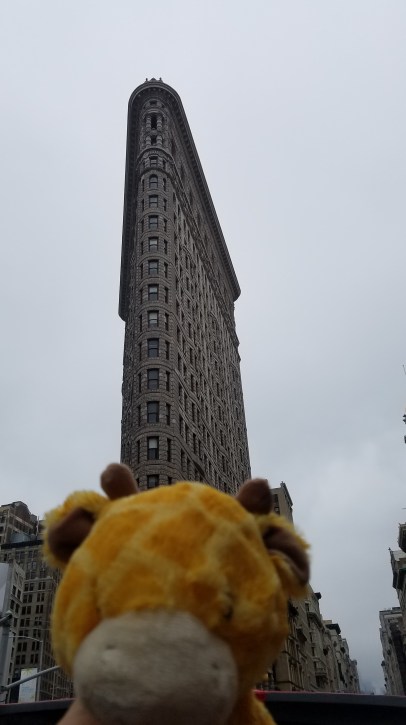
There was also a point that we went quite a few blocks without him saying shit. I didn’t notice it at first. Just assumed we had hit one of those spots in Lower Manhattan where there’s nothing interesting. I mean, what the fuck is a flatiron, anyway?

Flatiron

But no, turns out Dude was on his phone. He popped his head back up the stairs to look around a bit. Said something about the intersection of fuckwit and twattle, then popped back down the stairs. Dude was giving directions to someone. After an extended period of time, he got back on the microphone.

“Yeah, so this is Tribeca. Stands for Triangle Below Canal. And Robert de Niro lives right…”

His phone rings and he’s back talking to his buddy. But now his convo is bleeding through the microphone. No. I said twatwit and fuckle. My bus never goes to fuckwit and twattle.

Rather entertaining, but eventually we had to take advantage of the “hopping off” aspect, so we didn’t get to stay long enough for him to rant about all the Chinamen in his fine city nowadays.

We got off at the 9/11 Museum. And at this point, I’ll just say that I did the 9/11 Museum. Not much I can add if I want to stay tongue-in-cheek and/or irreverent. For now, just… wow.

When we jumped back on the next bus, after waiting about forty minutes and seeing three buses from the competitor company, the one that doesn’t advertise itself as “most buses in Manhattan,” drive by, we were relegated to the lower deck with the forty other people who were in line by then. No air conditioning. And for even more “fun,” the new narrator screamed every statement he said, each of which started “Alright, folks, this is…”

Fortunately we weren’t with him very long. But this was the first time I opted for the joy of the prerecorded narration. He was also the narrator that was most adamant about tips.

Our third experience was the Night Bus, which unfortunately did not take us to Hogwarts. But fortunately it was our best narrator. Not the brightest. No real history or architectural knowledge, as prone to distraction as the dog in “UP.” Most of her commentary followed along the lines of “I don’t know why that’s here” or “There used to be another building here” or “A lot of my friends like this pizza place.” Kinda felt like my four-year old was narrating.

But you know what? She was the best narrator we had. Nice and genuine. She started out the tour with a profound statement: Some buildings are really impressive during the day but you can’t even see them at night. Some buildings don’t do anything during the day but light up beautiful at night. And some buildings are wonderful no matter what time of day.

She’s the only one we tipped.

The following day, we took the uptown bus loop. It said it went to Harlem, but that’s being generous. It went just far enough to see the Apollo Theater, then it hightailed itself south like a wave of anti-gentrification, with a cursory announcement about Malcolm X as we skedaddled down the street named after him. Good job, bus company. Wouldn’t want to see where the Cotton Club or the Polo Grounds used to be. Langston Hughes, anyone? Y’all know there’s a huge artistic movement named after Harlem, right? But never mind. There’s the Apollo. Watch out for minorities. And hey, now it’s on to museums for the uber-rich.

The uptown loop also had no live narrator. I think it was supposed to have a live narrator. Other buses we saw had narrators. There was an employee on the bus with us, but he was just checking people’s tickets and playing on his phone while taking up a primo seat most of the time.

And the pre-recorded needs a little help. A bit obsolete. When it was describing the Tavern on the Green, it said it was closed for remodeling. I thought that was odd, because we had seen it our first day, one of the wonderful lunch spots we passed right after our shitty lunch. Then the recording went on to say it would hopefully be re-opened by the summer of 2013.

Hmm…. Might need to stop paying two hundred salesmen throughout the island and update the recording instead.

Also, the narrator changed when we got into Harlem. Not sure if “random white voice” was deemed inappropriate for Harlem. Or if the random white male behind the voice refused to talk about Harlem. Or, more likely, the route has changed since his 2012 recording.

The recording also repeated the same thing on both sides of Central Park, just like the live dude on the downtown loop. And it must’ve said “Watch out for low-hanging trees. Your safety is important to us.” about twenty times.

Maybe HAL was having a stroke. Again, I didn’t bother to check.

Of course, the best part about the uptown loop was getting to re-enact one of the best scenes in cinematic history. I present to you: The Stay-Puft Marshmallow Giraffe!

Stay Puft

New York, Part I

Wife and I went to New York (and Boston) back in June, so what better time for a patented Wombat Travel Blog. In the past, I’ve done this two ways: writing and posting what we did each day (the “Live Blog” approach), and waiting till the end to post one big summary.

This one will be a hybrid. There was a lot to do, little free time, and as an added bonus, this trip was sans in-laws, so it had alcohol! So I’ll be up front and admit that I’m writing a lot of this after I’m already home. And I intended to get it out quicker, but it’s grown past 15,000 words, so that took a while. But I’ll still split it up into five somewhat chronological and/or logical daily(-ish) posts, giving the faux-impression that it’s live. Hopefully it’s no more confusing than my usual fare.

But yeah, I know “Welcome to Margaritaville” has been closed for weeks and Pride happened a month ago.

As background, Wife’s never been to New York. I went there twice before. But the last time I was here, there were two giant identical towers on the southern edge of the island. I’m guessing nothing’s changed since the nineties, right?They don’t randomly, like, build 50-story buildings on a whim, right?

Oh hey, look what’s going up across the street from our hotel:

plane

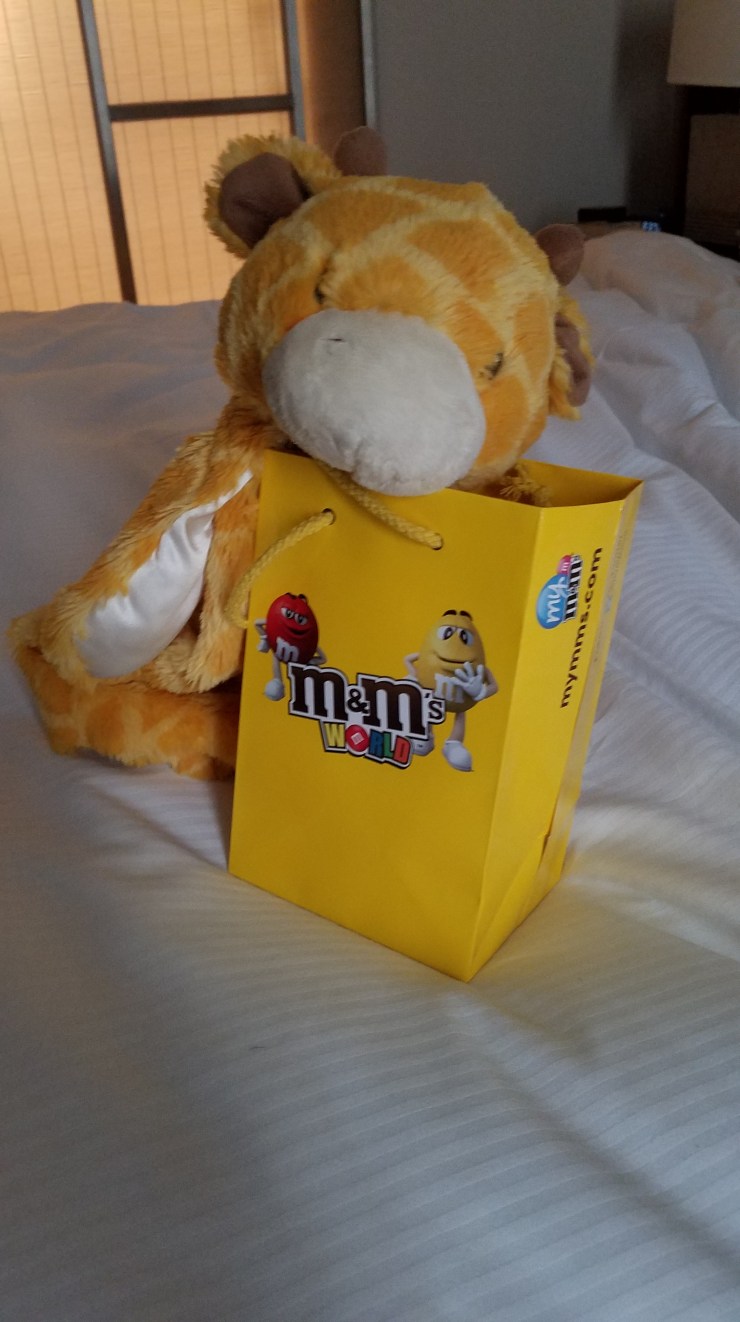
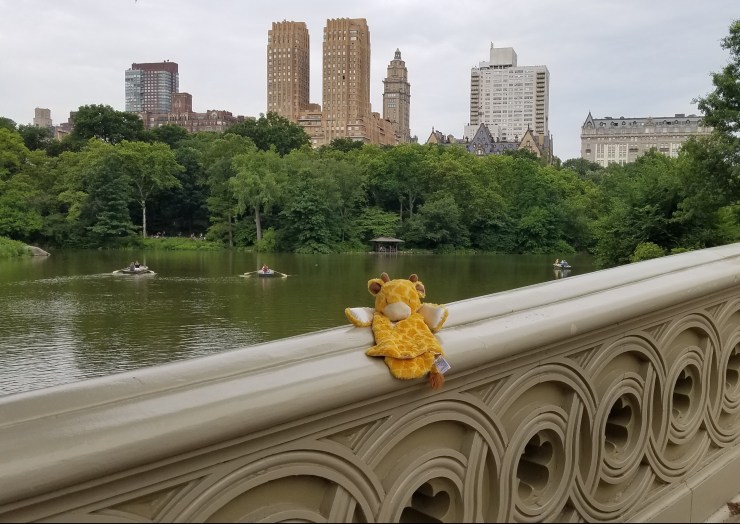
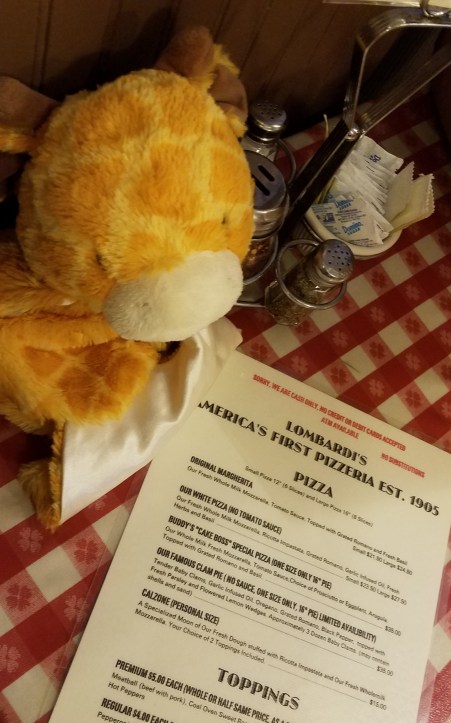
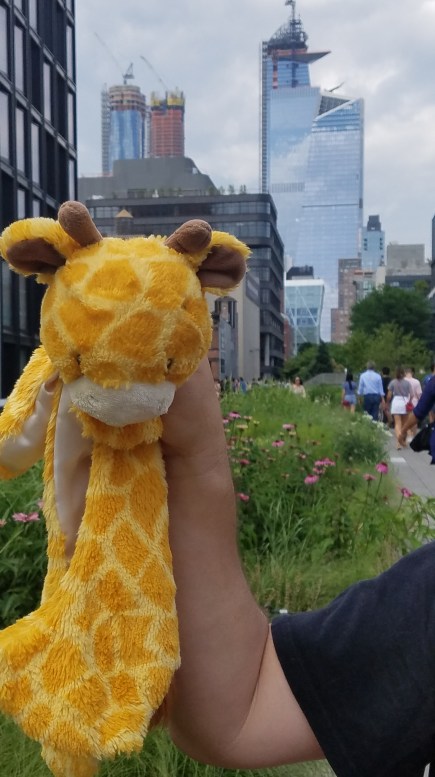
One more caveat: We left the child at home with the in-laws. She made us take her giraffe stuffed animal with us. So most of our touristy pictures will feature not us, but a stuffed giraffe. Enjoy!

Flight Redeye. Nuff said. We got a “free upgrade” to the emergency exit row. Not sure how, not sure why. They just called our name over the loudspeaker and asked if we’d be willing to open the door if need-be. I said sure. I know they try to sell those seats as an upgrade, so maybe if they can’t sell them, they give them away. But how do you pick the two people in a plane of 150 for the free upgrade.

Even better, we went from the fourth boarding group to the first. More time to get on that midnight flight and promptly fall asleep. Oh crap, I have to stay awake through the drill so I can answer “yes” when the flight attendant asks if I’m willing to open the fucking door. I’ve been through this rigmarole before. You can’t just nod, you have to say “yes.” To prove you know English. Because, as we all know,  “yes” is one of the last words anybody learns in English. It is the true barometer of English comprehension.If you can say the word “yea,” you are certainly capable of following complex instructions while plummeting toward your death amongst 150 other people similarly circumstanced and taking it all wonderfully in stride.

I read a book to keep me awake until the obligatory “yes,” and when I went to put it away, the seatback in front of me was way too far to reach. So I just put the book on my lap. And nothing helps you get to sleep faster than constantly being worried that you’re going to drop your book. Eventually I tucked it in next to my body.

But here’s the rub. If I’m planning on sleeping the whole flight, the extra foot room doesn’t do me much good. If anything, it made it a bit awkward. The seat in front of me will usually prevent me from slumping too much. Without that natural cocoon, I wasn’t really sure how to position my body to get comfortable. Do I sit straight up, with my legs stretched out in front? Do I curl up and tuck the legs under? Do I open my legs in a whore-pose? I didn’t know then and I still don’t know.

Also, my original “ungraded” seat was a window seat. I had booked it that way so I could lean up against the fuselage to sleep. My wife was similarly planning on leaning against me, but now neither of us had support to the side, and instead we both just lie there like a couple of unwrapped mummies. Plus, now I was in the aisle, so any time my elbow went into the aisle, someone brushed against it.

And all of a sudden I was wondering if my original seat was still available. I bet the rat bastards that were originally in this seat paid extra for a chance at sleep! And dammit, the plane didn’t even crash so I didn’t even get to open the door! Of all the luck.

So while I don’t entirely believe in the accuracy of my Fitbit at tracking my sleep when I’m in and out of consciousness, according to it, I slept one hour and three minutes on my overnight flight to New York. Can we say “refreshing vacation?”

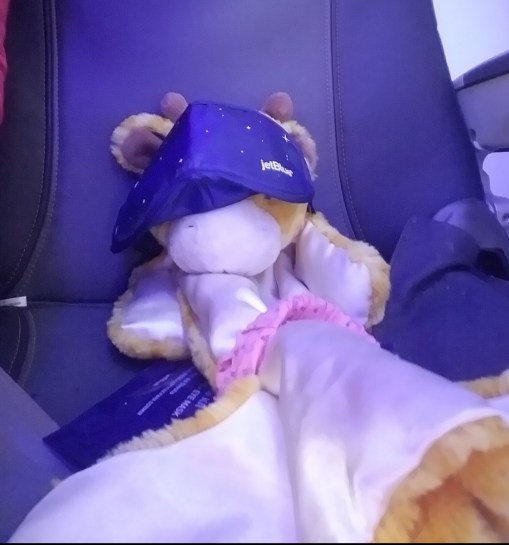
At least Giraffe got some sleep:

sleeping.jpg

AirTrain

After we landed, it was a chore just getting to where our New York experience could begin. We had to take the “AirTrain” from JFK airport to the subway station, then ride the subway into Manhattan with somewhere between one and three transfers, depending on how well I’m reading this map. The AirTrain doesn’t really go anywhere other than the subway, but it still is counts as its own entity with an entirely different ticketing system. We waited maybe ten minutes for the first train.

When the train finally arrived, naturally everyone flocked in. Then some dude got off the arriving train and waved us all away from getting inside. He kinda, sorta looked official, because he was wearing a red coat and who would wear a red coat unless it was required by the job? Plus he seemed to have a walkie-talkie sort of contraption.

Anyway, when he comes out of the front of the train and does his big wavy-hand, don’t-go-in-this-train move, some patrons had already started to sneak into the other three doors of the train. So red-coat dude follows some of those patrons in and shoos them back out onto the platform. Like “C’mon patrons, why the fuck would you just be walking onto a commuter train like that? Don’t you know you gotta be invited first?” This maybe takes two to three minutes. Then we’re all standing there in front of an empty AirTrain, doors wide open, wondering if this is some prank.

Dude talks into his walkie-talkie, gets an answer that seems to please him, then announces that this train is going to Howard Beach. Well shit. There are two spots to catch the subway, and Howard Beach was not the subway that would get me to where I wanted to go. In fact, only about ten percent of the people standing around are going to Howard Beach. They get on the train, red-coat dude goes into the train and pushes a button, then hops back out onto the platform with us and sends the poor souls off to their doom.

At least that’s what I’m guessing. It definitely seemed like a super-villain move.

After that, trains started coming more frequently. And I know they started coming more frequently, because I had to wait for three more of them. The next one, red-coat dude announces, is an inter-terminal train, so it’ll only go around in a loop and never make it to the subway station. The next train, wouldn’t you know it, is another fucking Howard Beach one. But at least this time I can verify it because the electronic sign that had previously just said a very ambiguous “Inter-terminal and Howard Beach and Jamaica Station trains all run on this platform” is now actually saying “Approaching train is a Howard Beach train.” That key piece of information was missing for the past fifteen minutes. We had only a red-coated, walkie-talkied dude to base our information on. And I’m not saying I don’t believe him, I’m just saying in this day and age, I believe the HAL that programs the digital instructions sign a little more than a fallible human.

BART always says what train is approaching and how long you have to wait for the one you actually want, by the way. Probably more on that tomorrow.

So twenty minutes and four trains after arriving on the platform, we’re finally on our way to Jamaica Station. Along with a shit-ton of other commuters.

And this is where the fun begins.

There’s no ticket booth at JFK, so you pay when you get off the AirTrain at the subway station. I guess I understand this policy. The inter-terminal train needs to be free, and the government wouldn’t want to make them accidentally pay for something they don’t need, right? Man, the government HATES when people overpay for things. That’s why taxes are so easy to file.

Unfortunately for me, whereas I could have bought at a leisurely pace while waiting the twenty minutes for our train, now all 150 people had to purchase their exit ticket at the exact same time. There were four ticket machines.

Now I’m totally admitting what happened next was my fault. I could have slowly taken my time to ensure I wasn’t making a mistake. I could’ve told all the people jostling for position behind me to go fuck the right off. I should not be susceptible to peer pressure. But I’m also the guy who looks in his rearview mirror every time I have to make a left turn, and if there are cars behind me, I’m gunning a much narrower gap.

So, while puffing out my back to protect myself from the Black Friday crush behind me, I selected which ticket I wanted to buy. I selected AirTrain. The next screen asked if I wanted to buy a discounted 10-trip ticket. With ten people clearing their throats behind me, I quickly thought it would be a good idea. I had just been looking into subway discounts, such as 7-days, unlimited rides for $32. So when I saw “Would you like to buy 10 discounted trips for $25?” I thought, Sure!

Do you see my error? Yeah. I just bought ten trips on the AirTrain, NOT the Subway. Because I’m clearly going back to the airport eight more times in my five days here… Fuck.

Well, I figured, maybe an MTA card is an MTA card and this one will allow me to get into the Subway anyway, right? Wrong. This ticket allowed me to exit the AirTrain portion and not a damn thing more.

So then I had to buy an actual subway ticket to complete my journey. Woo-hoo!  My first hour in New York, I hadn’t even made it outside of a protected environment yet, and I’d already spent a frivolous twenty bucks on something I didn’t even need.

Bring on Saks 5th Avenue!

Awaiting Delivery

Ye Olde “Locked Room” Story.

Well, the room isn’t really locked. Characters could leave the room, but the story couldn’t.

The judges said they liked it, but I think they wanted more backstory. They said they wanted details as to precisely when it was happening. Evidently, “thirty years after the Austro-Prussian War” and “The Bavarian (Chlodwig Carl Viktor) is chancellor of Germany” weren’t big enough hints. Are they saying not every reader that will ever view my writing isn’t an expert in late nineteenth century German politics?

They also wanted more backstory with the father. But the contest runners had said backstory shouldn’t be outside of the room, so I tried to toe the line a little.

Here ya go:

Awaiting Delivery

The room is sparse. The only real furniture is a small writing desk in the corner and a twin-sized bed along the opposite wall. The bed and its frame are locked in a competition to be the most lackluster. The latter is a collection of four steel legs with a few black splotches to indicate that, somewhere in its distant past, it might have attempt to provide some hospitality. The former is a stripped-down, flat piece of cloth with a permanent indentation down the middle, representing those countless prior inhabitants who might have seen the frame in its former glory.

Grey, clinical walls. Or perhaps not clinical, but regulation. Everything about this room is uniform and regulation. Nothing extravagant. Nothing inviting. No indication that the visitor is welcome.

Which is a shame, Margaret  thinks she will spend a fair amount of time here. How long, she is not quite sure. The strange, alien language being thrown around in her presence conveys little information Margaret can use. But the clipboard and the inspections and the pointings tell her this is her new home.

Not much to look at inside the room. But the view outside the room is simultaneously majestic and infuriating. Visible through a thick, warbled window, both a bit too thick to give a true sense of its view, but opaque enough that the sight cannot be ignored. The most inviting sight in all the world, mocking her by denying entry.

“Ha famiglia in l’America?”

Margaret looks up at the new entrant, confused. She doesn’t understand, but she is closer to understanding than before. This language is not quite as foreign as the one that everyone else is speaking.

The speaker of the new language looks back at Margaret in equal confusion. Her dark eyes, curtained by two, even darker, locks of hair that have broken free from the tight bun atop her head. It has been a long day for her, yet her white smock is as pristine as the moment she got off the boat this morning, a short boat ride by comparison. The only evidence of the day’s stress is those two strands of hair out of place.

Still, the worker can’t worry about her hair right now. Her days are always long, and this day will be longer if she can’t communicate with the residents. That is precisely her job, her profession. And her experience tells her that the last question should have produced a response. She looks down at the clipboard in her hand, looks back up at Margaret.

“Mi hai capito, Senora Maguerita?”

French? Margaret doesn’t think so. It sounds close, similarly sonorous. But the French don’t enunciate the way this olive-skinned girl does. Which probably means one of the other Latin languages.

“Keine Franzosisch,” Margaret says.

They are the first words Margaret has spoken since arriving. Words don’t have much meaning when nobody understands. Everything about this place is designed to avoid verbal communication. Solid yellow lines, signs with pictures, drawings with numbers attached, clipboards.

And pointing.

Pointing, pointing, and more pointing.

Margaret followed the yellow lines and the signs and the pointing. She nodded when the workers, in their white smocks or their grey shirts or their black jackets, said things to her in their alien tongue. She was starting to wonder if this new land was nothing but silent compliance.

Except this woman addressed her differently. No pointing, but a pen poised above the clipboard. She was waiting for a response. Expecting a response. So Margaret responded.

“Keine Lateinish.”

“Tadesco?”

The social worker with the two strands of loose hair turns to the other official in the room. This one, a gaunt man wearing a grey coat over a crisp white shirt and regulation-red tie, looks back at the woman in the smock, then to Margaret. There is no understanding between any of them. Here they are, three people in the same room, speaking three different languages.

“Scusi,” White Smock says. “I meant German. I think she is German.”

Finally, a word Margaret knows. She is German. Not that she calls herself that. None of her people think of themselves as German. Her language is Deutsch. And, increasingly since the unification, people are calling Deutsch their nationality, too. But it is slow going. Margaret still thinks of herself as Bavarian most often, even if that particular state ceased to exist when she was three years old.

But German, she knows, is the word that the English called the Deutsch. And Americas is just a mini-England. Typical of English arrogance to not call a people what they prefer to be called. Bismarck had been wrong about a number of things, for which the Kaiser had rightly fired him and finally, after one more misfire, replaced him with a proper Bavarian. But one thing Bismarck had been correct about was how the rest of the world saw the upstart Deutsch. Like little kids, only capable of breaking things.

“Ja.” Margaret seizes upon the word she knows, even if it is insulting and diminutive. “Ja, ich bin deutsch. Um, German.”

The man with the regulation tie and regulation shirt and regulation coat raised his bushy eyebrows above his bushy mustache. The mustache was not regulation, and had been out of the norm since the Chester Arthur administration, but government officials are not always known for being up on fashion.

“You’re German?” He asked. When Margaret doesn’t immediately respond, he points to her. Always with the pointing. “German?”

“Ja. Yes.” Margaret follows suit, pointing at herself. “German.”

Mustache Man and White Smock both lean in to look at the woman’s clipboard. The man scratches his head.

“Well then I guess you should go get a German translator.”

The man pats the social worker on the rump in an act of dismissal. The woman takes the gesture for what it is and turns to leave. Margaret now assumes she must have been Italian. She used the word Tadesco for German. That is not a reference Margaret knows, but she is at least cognizant enough to know that the French refer to her people as Allemand. One cannot grow up in the aftermath of the Franco-Prussian War without knowing some of the words used on each side.

Tadesco. Allemand. German. Every country has their own word for her people. Just as long as nobody respects them enough to call them by their own name. Here she is, barely considering herself German, but now fiercely defensive of the idea. Immigrants are always much more unified in America than they were back home, she has heard. You may not be Deutsch now but you will be when you’re off the boat. And here she is, off the boat and separated into a room from which she may never escape, and she finds herself more Deutsch, more German, than ever before.

Nationalism at its finest.

Margaret feels awkward being alone in the room with the man. She wonders if he is going to pat her on the rump like he did the Italian woman. What would she do? There isn’t anywhere to go. And this man holds her future in his hand.

But the man doesn’t move. Perhaps he only touches those he works with. Those he is superior to in an official sense, as a superior and a worker, and not just superior in a generic sense, as a native to an immigrant.

Or perhaps Margaret’s current state is working as an agent in dissuasion. It has been months since a man has looked at her with any sort of lust. Not when she is so clearly lusted out.

The man merely stands near the doorway in something akin to attention, albeit with his hands clasped in front of his stomach instead of rigid at his side. His eyes stare straight forward from between the two forests warring on his face, his gaze encompassing all of the room and none of it at the same time. He will stop her from trying to dart past him, but short of that, he will let her have the run of the room. And in Margaret’s current state, she won’t be darting past any guards or doors.

Feeling secure, if not safe, Margaret puts her hand on her lower back and turns away from the government worker and all of his facial hair. She once again looks around the room, her new home for the foreseeable future. It remains sparse. The desk has a chair, which looks much more inviting than comfortable, but there will be plenty of time to sit there later. And to lie on the bed.

For now, the only thing worth seeing is through the window. Margaret walks closer, hoping to get a better view of the azure heaven lying beyond. Warbled as it is through the window, it still sends a clear message of potential. Painted above a deeper indigo sea beneath, the two blues meet together at a not-too-distant horizon, where another island, a larger island with buildings and people and commerce, lay.

And between Margaret and this land stands the guardian. This Statue, Lady Liberty, shows her profile to Margaret and all of the previous and future residents of her well-worn room.  She looks out to sea, to all of the incoming immigrants, her hand raised in the international sign for “Stop!” The torch in her hand might be a firearm, preparing to shoot any trespassers who deign to sneak behind her billowing bronze skirt into the land beyond. The book in her hand, so similar to the clipboard in the hands of the various smocked and suited and coated officials in the officialdom Margaret finds herself in. Like the Italian lady who had left Margaret alone in the room with the mustachioed statue behind her, guarding the exit from the room as surely as Liberty on her pedestal in the ocean guarded the exit from the island.

“Frau Marguerita?”

The new voice pries Margaret’s gaze away from the locked gates of Heaven. Another woman in another white smock with another clipboard stands next to the government official now. This woman has blonde hair and blue eyes, but other than that she might be the same person. Same age, experienced enough to be fluent in two languages, but young enough for a mustachioed man to pat on the rump. The smock fits her the same way, hanging loosely to avoid any personality being exhibited from bodily proportions, the same way Liberty’s dress falls around her own steel frame.

“Heisen sie Frau Marguerita?” The new arrival asks in German. “Is your name Mrs. Marguerita?”

Finally, something Margaret can respond to.

No, I am Mrs. Shengel.” ,” Margaret answers, also in her native tongue.

So sorry.” The woman writes something down on her clipboard. “Someone copied your last name down as Marguerita, so they assumed you were Italian.”

My first name is Margaret. Margaret Shengel.”

The woman nods without looking up from the clipboard. “Good thing you responded in the negative or else your name would have officially been listed as Stephania Marguerita and you would have been delivered to Brooklyn.”

“They can do that? Just change somebody’s name?”

“We try not to. But it happens.” 

The translator shows her clipboard to Herr Mustache, points at what is written there, and then hands the clipboard to him. He takes the top paper  from the clipboard, returns the clipboard to his co-worker, and leaves the room. Margaret notes that the German-speaking woman doesn’t touch any part of the man on his way out of the room.

I am Anna,” the translator says when the two of them are alone in the room. “Please have a seat.”

She points Margaret toward the desk chair. Margaret hobbles the three steps away from the window and tries to ease herself down but instead plops into a seated position. The chair squeaks.

Anna sits on the edge of the bed, crossing her legs in a friendly, on-your-level stance. The mattress does not shift at all under her weight, and Margaret is impressed she doesn’t sink toward the central indentation.

Was Anna your original name or the name they gave you here?” Margaret says with a smile.

Both,” Anna responds with a smile of her own. “We honestly don’t change too many names here. We try to avoid it.

We. Margret notes the word choice. Anna is part of a “we.” Margaret is still part of a “you” or a “they.” Until she can leave this room, she will always be a “they.”

You say you are going to Milwaukee,” Anna says, looking down at the piece of paper left on the clipboard in her lap. “Do you have family there?

My brother,” Margaret lies. Her brother has been to Milwaukee before, but he is back in Bavaria, back in Germany, now. But there are many Germans in Milwaukee. A community to take care of her and her child. A chance for her to be part of a “we” again.

“Mmm, hmmm.” Anna writes something down. “And that is the Hans you wrote?”

“Yes. Hans Stengel.” Margaret responds, immediately knowing she should not have said it. Would they already know the whereabouts of Hans Stengel? Certainly the name must be common enough. Or perhaps the real danger lie in her and her brother having the same last name.

“And the father?”

Margaret acts confused. She knows where this line of questioning is going, but she hopes to avoid the subject. She decides to be intentionally obtuse, in the hopes of steering the conversation.

“My father died in the war.”

Now Anna is confused. “Is there a war I’m unaware of?”

“The Seven Weeks’ War.” Maybe Anna is too young to have heard of it.

“That was thirty years ago.” One does not work in an immigration station without being up on all of the push and pull factors.

“Yes. My mother was carrying me at the-,”

“No, I’m sorry,” Anna interrupts Margaret’s narrative. “I mean the father of…”

The interpreter points toward Margaret’s enlarged womb. Margaret nods.

“Is the father of your child in Milwaukee?”

“Yes,” Margaret lies again. What else can she say? For all she knows, the father of her child might actually be in Milwaukee. She hasn’t seen him in eight months. If there’s anyone in need of a fresh start, it’s Margaret.

“And his name?”

“Mikkel Jensen.”

This time Margaret need not lie. That snake is assuredly the baby’s father.

“And you are Stengel? Are you to be married?”

Margaret nods and resumes the lie. “That is why I have come. To be married before the baby.”

“How far along are you?”

“Six months.” 

One last lie. Margaret doesn’t want to go back on the boat. There is only one direction she can leave this room in, and it is toward the Statue.

Anna raises her eyebrow at the claim. But fortunately, Anna is young. As was the Italian woman. Margaret’s hope rests on the propensity of mustachioed gentlemen to hire damsels of the younger ilk. If Anna had given birth herself, she’d take one look at Margaret and, in order to preserve the” we,” push her right back on to the next boat back to the Old World.

Margaret wants her child to be born in America. If the child is born here, he will be an American, and so, by extension, will she. She knows the stories, and she knows the customs. If they think she is close, they will put her back on the boat. If they think they have time, they will investigate her claims. Look all over Wisconsin for a Hans and a Mikkel. And by then…

Okay, six months.”

Anna writes something down on her clipboard, and now it is official.

You are being quarantined,” Anna speaks aloud the German translation of the official statement she has recounted numerous times, “pending official investigation of your claims. At that point, so long is there an American resident to claim you, you will be allowed onto the harbor boat for entrance into the United States.”

Margaret pats her stomach. There will be an American resident in a few weeks, she knows. In fact, an American citizen.

“In the meantime, please make yourself at home. This room is yours. The latrine, complete with flushing toilets,” Anna pauses for effect, as many immigrants gasp at this mention, “is across the hall. You may go to the cafeteria at meal time. Or, in your current state, you can request food to be brought to you.”

“Thank you. Thank you very much.”

“You also might want to go see the doctors. To check on the health of your…”

Anna again gestures toward Margaret’s stomach. Margaret silently thanks God for giving her a girl so squeamish about nature as to not even be able to reference the very evidence of said nature right in front of her.

“I know that my child is very healthy,” Margaret says, placing her hand on her stomach again.

Anna stands up. “Welcome to Ellis Island.”

“Thank you.” Margaret strains herself out of her seat and shakes the translator’s hand, a custom she hears is the normal form of greeting in her new home.

“Yes. I am off to file your paperwork. You should have an answer in four to six weeks.”

“Wunderbar!”

Margaret turns back to look out the window. Six to eight weeks? She won’t even need half of that. Within a month, the Statue of Liberty will be admitting her and her child to the land beyond.

And don’t forget,” Ann says from the doorway behind her. “You can see the doctors at any time.”

I most certainly will,” Margaret responds.

Anna leaves the room and shuts the door behind her.

“At the right time,” Margaret says to her womb.

For now, though, she might as well get used to her new room. Her new life. Her new world.

Cuckoo for Coconut

I really like the latest food fad.

Which worries me. Because a fad is bound to fade. And I don’t want another bacon.

Remember bacon?

Bacon was once a breakfast staple. Then somebody decided to put it on a burger. And it was good. And the world said, “Wow, I hadn’t thought of that.”

But let’s face it: bacon is awesome. Fat, crunchy, and salty are the cornerstones of any healthy diet.

Sorry, did I say healthy? I meant American.

The real fad part of the bacon journey wasn’t when it took its natural spot atop hamburgers, though. That came in the early aughts, when we started bacon-wrapping everything. Some of it was great. For instance, if you cover your meatloaf with bacon, it protects the outside, and the fat renders down to keep the whole thing moist. Plus the salty and the crunchy still work.

Hell, Emeril Lagasse made an entire career out of it.

But then we went overboard. Some things aren’t meant to be wrapped or rendered in fat. Ever been able to actually eat a bacon-wrapped item on a stick? The bacon loses its structural integrity as soon as you bite into it. Unlike a corn dog, where the rest of the sheath remains intact as you eat it, once you bite into a bacon-wrapped hot dog on a stick, you’re stuck with half a slice of bacon hanging from your mouth (or falling to the ground) with the remaining “entree” being 100% hot dog.

I have yet to meet the french fry that can hold onto its bacon bit all the way to my mouth. And don’t get me started on cheesy fries.

Then we started infusing things with bacon. Of course, to “infuse” something is supposed to mean steeping it in liquid over time. But in practice, it usually just means you add a flavored syrup. With a bacon infusion, you’re losing most of what makes bacon good. The crunchy is gone. The wonderfully-marbled curve of fat, that mouthfeel of heaven, is replaced by a vague smokiness. And I don’t care how many times the Food Network repeats the lie, smokiness and fat aren’t the same taste.

So when you take a shot of bacon-infused vodka, you’re basically just gulping down some alcoholic seawater. I tried a bacon soda once, which I’m pretty sure was just a dirty dishrag strained through a sugar cube.

When Peak Bacon hit, you couldn’t swing a blood pressure monitor without hitting some bacon-flavored contraption. When someone, probably Guy Fieri, proposed bacon-wrapped, bacon-infused bacon, we should have known we’d gone too far.

Remember the chocolate-covered bacon? Yeah, nobody could admit this at the time, but it was never all that good. You never got the proper mixture of the different flavor profiles. It was usually a sweetness on the front, although not too sweet because it was usually dark chocolate, followed by a flood of salt. You never fully got the chocolate flavor, and even the bacon was just lost in the salt. Some brands have forayed back into that realm recently, when you can do it with neither fanfare nor eye-rolls, and I think some of the modern candy bars are getting closer to a proper blend of bacon and chocolate, but it usually needs to be done with bacon bits, not giant strips in the middle.

Of course, I never would have admitted to that opinion back during peak bacon. Saying anything with bacon wasn’t wonderful in 2002 was kind of like admitting to being a communist in 1952. You only did it behind closed doors with people who had sworn a blood oath. Nothing said “Unamerican Activities” more than “it’s a little too much bacon.”

And then, poof, before you knew it, bacon became blase. That bacon-wrapped everything booth at the state fair went from an hour-long line to a walk-up-and-get-it booth. I think the last time I was at the state fair, the deep-fried catfish had a longer wait than the chocolate-covered bacon. Cause deep fried never goes out of style!

All of a sudden, a restaurant that carried more than one bacon item seemed like it was trying too hard. Saying a new bacon idea sounded intriguing became the equivalent of shouting out ‘Murica. If you’re not doing it ironically, you might need an intervention.

That’s the way fads go. Put bacon on your ice cream now, and you might as well be wearing a mullet.

Over the past decade, we’ve had a few smaller food fads, but none of them have approached the bacon craze. They tend to pop up for a season or two then fizzle out. For a little while there, I thought bleu cheese/gorgonzola was poising itself for a breakout. It started popping up in more foods, starting, much like its bacon forebear, in burgers and pastas. Salads started to come with bleu cheese dressing AND bleu cheese crumbles.

But bleu cheese is too intense, too pungent, a flavor for a lot of people. It has a tendency to overpower whatever it is paired with. So does bacon, but maybe we’re learning. Whatever the reason, it never went mainstream. I don’t envision any gorgonzola cookies in the near future. We never bleu-cheese Torani coffee flavoring. No bleu-cheese margaritas, although I’m pretty sure I’ve seen it in martinis. Bleu cheese seems to have settled into an accoutrement, slowly expanding its foothold over the past twenty years.

And I’m good with that, because I like bleu cheese and I don’t want it to go away.

A few years ago, New York Magazine predicted that the “next bacon” would be pumpkin. There are certainly some parallels. Pumpkin’s grown from its dessert roots. It went the coffee route instead of the burger route, because tying yourself to an addictive chemical seems a pretty sure bet. I’ve started seeing dinner pumpkin casserole recipes pop up in my social media feed. Last autumn, there were at least three cereals that came out with pumpkin-spice flavors.

But while I can see pumpkin extending its autumn empire more, I can’t imagine it expanding its borders to become a year-round flavor. It’s a hundred degrees where I live right now. When my armpits and crotch are setting new world records in the World Cup of Moisture,  a nutmeg and clover-flavored squash sounds about as appealing as an adult diaper. For dinner.

Which leads us to the current trend. I wrote about it a little bit in my Hawaii posts, but I love me some coconut, and the month of June seems to be prime-coconut time.

Like some of the previous fads, the flavor can come from multiple sources. Unlike bacon, the extra sources are usually still legitimately coconut. The shredded coconut has a texture that’s rare in other foods, almost crunchy and chewy at the same time. As a milk or water, it has a sweeter element to it.

And, of course, there’s the Torani flavor.

Over the past few summers, coconut seems to be venturing beyond its home base of desserts. It’s made some pretty serious inroads into the coffee and health food fiefdoms next door.

You didn’t know the dessert and health food fiefdoms are next to each other? You must not have the same culinary map as I.

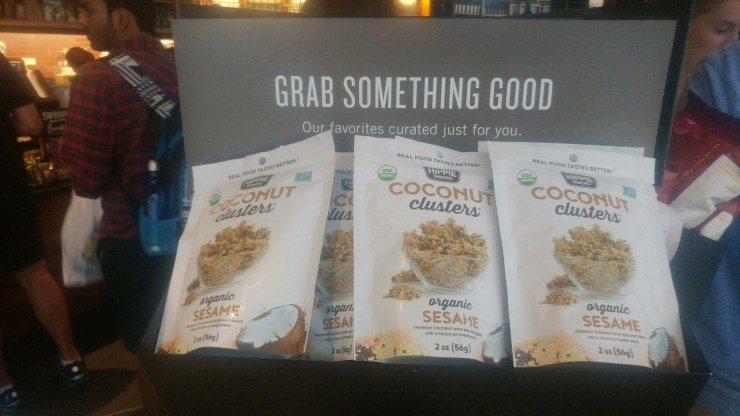
So far, I’ve been loving this coconut expansion. As I mentioned when I was in Hawaii, my wife is no fan of the flavor. She was hoping to give me so much coconut in Hawaii that I would be done with it when I got home. No such luck. All she succeeded in was making me aware that these wonderful Coconut Clusters are available in Costco on the mainland, too!

And hey, I just saw them at Starbucks:

coconut

Then there’s the whole coconut oil, coconut water thing. Coconut oil was briefly being sold as a healthier alternative to vegetable oil. Then there was backlash because it has more fat. Somehow it’s the second decade of the twenty-first century and we can’t figure out that healthy and non-fat aren’t always the same thing. As for the coconut water, I’m not particularly a fan. It doesn’t really taste like coconut, nor like water. It’s just a sweet water. Maybe it “hydrates,” but it doesn’t quench my thirst. But unlike the oil, coconut water doesn’t seem to be going anywhere. Every time I’m at the grocery store, there seems to be some new flavor.

But this is where I start to get worried. Because if coconut expands too fast, or if it starts to cross over into non-coconut friendly areas of the menu, there will be a backlash. The M&Ms were fine. The coated seafood? Okay. Potato chips? I’m starting to get worried. Sure, the chips “made with coconut oil” are one thing, because they don’t taste like coconut. Trust me. But I just recently saw a bona fide “red curry coconut” flavored chip. Naturally, I bought it.

Then saw a menu that put shredded coconut on steak. And to that, even I have to say: “Dammit, coconut, you’re going too far!”

I’m sorry. I take it back. Oh, coconut, I’m going to miss you when nobody will be caught dead trying a new fusion of you.

There might be one saving grace from the future backlash: if coconut becomes the summer flavor. The first time I noticed the new incarnations was at Peet’s Coffee two summers ago. They had a coconut latte. It was delicious. They had a coconut black tie, a mixture of cold brew coffee and condensed milk that they usually do with chicory. It was also delightful. I kept going back to order them. Then one day, probably in early September, I popped in to order a coconut latte, and the barista said, “Sorry, we just switched over to pumpkin spice.”

Oh, so that’s how it’s going to be. A little bit of forewarning would’ve been nice, but whatever. I guess I’ll just wait until May to get my fix again. Shit, how far away is May?

But maybe that will keep things fresh, like the McRib of good taste. Wow, did I just write McRib, fresh, and good taste in the same sentence?

But seasonal flavors have a way of lasting past their shelf life. Pumpkin spice isn’t going anywhere. We roll our eyes at it, but the phrases Autumn and pumpkin-spice are damn-near synonymous. Just like eggnog has its hold on December, although it seems to be ceding ground to whatever the hell “gingerbread spice” is.

So maybe coconut will become the summer flavor. I don’t know what’s so summery about it, because as I said, I don’t think sweetness quenches thirst. But I’m not going to question it as long as it stays relevant.

And I’ll just ignore the fact that Peet’s now keeps the coconut black tie year round. Dammit! Don’t ruin it, guys.

In the meantime, I’m going to go put my head in the sand.

Or maybe my feet.

With a pina colada.

Poisoned Parlance

I just came back from a vacation, which I’ll be blogging about in the near future. But in the meantime, to assuage all of my fans, or my only fan (HI MOM!!!), here’s another flash fiction.

The theme was facing fear. I wanted to go with a more mundane fear, so I went with public speaking. Then I threw in the stammer, cause they never specified whether it needed to be an irrational fear.

The judges said they wanted more backstory of the main character and his friend. How/why he was invited to be the Best Man/Toast Giver. They might have a point. I certainly made it up as I was going along, and by the time I was done, I could really only edit for errors, not add a shit-ton of content and context.

So now you, intrepid explorer, get…

Poison Parlance

My adversary stands before me as I rise from security. Legs tremble, ready to pounce, fight or flight instinct fully engaged. Except there’s no place to go but forward. Into the face of evil.

It rises in front of me. Solid, erect, pockmarked visage eyeing me warily. ​A soft, guttural hiss emanates from its mouth.

“Snakes. Why did it have to be s-s-snakes?”

It’s not a snake. But I hoped an Indiana Jones line might calm me down. It didn’t.

I wish it was a snake. I could throw a fucking brick at a snake. Not that I have a brick. But at least a snake is a mortal being that can be killed.

I inch toward it. Dragging every ounce of my body, every ounce of time, in an effort to put off the inevitable as long as I can, despite knowing this goes against the priority of getting it all over with as quickly as possible.

Bright silver in the blinding spotlight, hissing and spitting and crackling, stands a microphone. Why did it have to be a microphone? Why the hell did it have to involve me, standing in front of a group of people who I barely now, who I can’t really see, and delivering a canned speech?

Thanks a lot, Ron.

My great aversion to public speaking came during adolescence. All the great social phobias do, right? Kids will take the stage at all-ages karaoke, belting out that song from Frozen at the top of their lungs, completely oblivious to the faces in the audience cocking to one side like a dog, one eye pinched in the universal sign for “you’re a half-note flat.” The kids just keep singing like they’re Idina fucking Menzel.

Hey, remember that time John Travolta butchered Idina Menzel’s name at the Oscars? He called her Adell Dazeem, or some shit like that. That should make me feel better, knowing that even people who do this type of thing for a living can make a faux pas in front of a microphone. But all I can think is that if John fucking Travolta can’t deliver a prepared speech without fucking up, what the hell chance do I have?

“Thuh” I say into the microphone. “Thanks.”

The reverberating echo of my voice sounds tinny, unnatural as it comes back to my ear. I hate recordings of my voice on phone recordings, too. But at least an answering machine doesn’t come with threat of feedback.

“Ron asked me to…”

My tongue tastes desert. Arid, dry, probing for moisture that should exist somewhere in its environ. But all it finds is the jarring back of teeth and a palate as dusty as the cratered surface of the moon. Or the soundstage where Martin Scorsese directed Neil Armstrong to bounce around a bunch. Whatever. Right about now, I’m thinking if scientists haven’t figured out a very basic hydration formula for the inside of a mouth that is trying to speak into a microphone there’s no way in hell they actually made it to the moon.

Or maybe it’s the alcohol’s fault. I have a friend who is afraid of flying. She drinks before a flight. Suggested I do the same here. Plenty of free booze at this place. Except that she can pass out on a flight. If I pass out right here, in front of this microphone, as I desperately want to do, it would probably put a damper on the mood of the crowd. My mood be damned.

“Ron asked me to…”

I did some reading in preparation for this. Don’t make eye contact, the website said. Look above their heads. Except I had a teacher in junior college who did that. And it’s pretty fucking obvious when someone’s looking at the top of your head. Maybe someone in the front row might think you’re making eye contact with someone in the back row. But if you’re sitting near the back, where the people who are most likely going to mock you are sitting, it’s obvious that you’re just staring at the back wall. Hell, sometimes my professor’s eyes rolled up in her head like the goddamned Exorcist, staring straight at the ceiling. Half of us could have snuck out of the room without her noticing. She’d probably just respond by spinning her head around and projectile vomiting.

And trust me, noticing all the miscues of other public speakers does wonders for somebody with public speaking foibles himself.

“Ron wanted me to s-s-say… ssssome things about how him. And, um, J-J-Jake.”

The presentations in middle school were bad. I think that’s where it started. Who the hell decided that middle school students should have to do class presentations? Hey, you’re going through puberty! Acne up the wazoo! No control over your body odor, not to mention all of those other bodily functions! How about you stand in front of a group of your peers, who will continue reminding you of your failures and foibles every day for the next six years?

I didn’t pee my pants that time, at least. I saved that particular reaction for high school. Romeo and Juliet can go fuck itself. Because, again, freshman year doesn’t have enough shit to weigh a fourteen year-old down. Let’s add a mortifying incident that will consign him to the hallway shadows for every passing period in the next three years.

No, in middle school, it was only a profuse sweating. Just enough to make me never want to do this shit again. Yet here I am, a decade later.

“I’ve, um, I’ve  known Ron since middle school. But we didn’t really hang out till high school.”

I seriously thought of telling Ron no. It wouldn’t be the first time. I’ve had a chance to be a groomsman before. I’ve always said no. They act like being a groomsman is such an honor. Stand up there and make me look good. Tell some carefully-sculpted anecdote that Aunt Gertrude, whom I haven’t spoken to since I was eight, can go home and tell her knitting circle that her nephew’s living a full life. 

Not that anyone with half a brain would want my sorry ass standing up for them. Best Man? More like worst. Nothing brings a party to a screeching halt like a minute of dead silence, broken by an occasional stammer. Stammer is sexy. Just ask all of the zero girlfriends I had before alcohol became involved.

But Ron was one of the few people who didn’t hold it all against me. High school as much hell for him as it was for me, just for different reasons. He hadn’t come out yet. Maybe he didn’t know himself yet. But he knew he didn’t fit the mold. Neither of us did. Me, because I couldn’t talk about Romeo and Juliet. Ron, because he liked Romeo and Juliet way more than any ninth grader should.

“Ssssso. I know Ron doesn’t have a l-l-lot of friends from high school. Neither do I. High school kinda suh-sucked. For both of us.”

Way to go, asshole. That’ll slay the crowd. Aunt Gertrude’s gonna have her girders in a bunch after this shitshow.

Imagine all the people in the audience naked, they say. Except, looking around, I really don’t know that I want to see any of these people naked. Except for maybe the bridesmaid, but that’s clearly never going to happen.

I guess she’s not a bridesmaid. There’s no bride. Best maid? Does that make me the Man of Honor? Semantics are stupid. Maybe I should just say that into the microphone.

I never understood how the whole “imagine them naked” thing is supposed to work. Am I supposed to be clothed? Like that episode of “Westworld,” where they’re having perfectly normal conversations in front of an orgy?  I imagine if I was the only clothed person in a room with a hundred naked people, that would be weird. That would not calm me down. I would assume I got the invitation wrong, and if I’m already self-conscious about standing in front of them, then being the only one that didn’t get the memo isn’t going to make me feel more comfortable.

You know what? Probably not the best time to be thinking about “Westworld” and orgy scenes.

Or maybe the “everybody naked” thing is supposed to have me naked, too. Like, we’re all in this together. They’re just as humiliated as I am. Except they’re sitting down, legs crossed, privates underneath a wedding program, and I’m standing in front of them, behind this crackling, feedback-prone microphone, and now I’ve got my shwantz out for the whole world to see. One more thing to be self-conscious about.

“S-s-sorry. I, um, this isn’t about, um, ssschool. It’s about, um, Ron and… um, Ron and Jake.”

I’m off script. Good thing, too, because I can’t read the fucking script., because it’s crumpled in my hand. I’m shaking like a Parkinson’s patient. That eighth-grade, puberty sweat is coming back. Sure, I know about deodorant now, but I didn’t have to wear a tuxedo in middle school. It’s a wash, at best, but thinking of a wash just makes me perspire more.

Off script. What made me think I would be able to read pre-written remarks, anyway? Do I even know my own cadence, or lack thereof?

Like in theater. My dad made me do the school play in tenth grade. He was one of those “make the kid smoke a carton to get over his interest in cigarettes” kind of guys. Figured if I was gonna be a pansy-ass when it came to speaking, he’d get it out of me by humiliating me. I stammer because I can, right, dad? If I’m put on a stage and forced to sing along with the chorus, I’ll spit it out, right?

Or I’ll just knock my fucking knees and faint on stage. Right at the front, near the orchestra pit. Thank God for the gong player. That cushioned mallet raised above his head for the big strike really helped break my fall. The gong player definitely wasn’t thanking God for me though, that’s for sure.

Ron’s father isn’t here, either. He’s probably still back at home, praying the gay away. Maybe that’s what drew the two of us together. A couple of ripe old assholes taking care of us in our formative years.

“Ron met J-j-jake at one of those… after the G-g-giants won.”

Oh shit, they might not know what I mean.

“Not the football. B-b-baseball. The Wuh. The Wwworld Suh, suh.”

No shit, dumbass. We’re in Northern California. Who the hell would think we were all out celebrating Eli Manning. And maybe I shouldn’t add in how Ron had spent the whole game gushing over the abs and thighs Buster Posey must have to be able to squat behind the plate for three hours and still leg out an infield single. Or maybe I should add that anecdote in. That’s real life. Shows his mindset. How the only two gay guys in a sports bar of toxic masculinity can find each other when they’re least looking.

Except that’s not how it would come out. Yeah, I can come up with wonderful lines about toxic masculinity inside my own head. People assume I’m dumb because I can’t enunciate my thoughts. Or just because I’ve now been standing in front of this microphone, radio silence, for what has probably been ten minutes now.

Why the hell did Ron even want me here? Sure, I’m one of his best friends. Yeah, I was there when he met Jake, but is that really a vital piece of information? I already fucked up the delivery of it once. So now all I can do is fumble over part two of their relationship. The bridesmaid is here for a reason, too. Can’t she add anything to the “how wonderful you guys are together” story?

Or Ron could come up here. Or Jake. Aunt Gertrude will talk about how strong of a public speaker he is after that debacle of a cavalier.

I know what I want to say. I want to talk about the change that has come over Ron since he met Jake. The sparkle in his eye, the new way he sees the world. The subtle, little optimisms where there would’ve been sarcasm. His propensity to talk about plans in weeks and months instead of minutes and hours. How the true Ron, the one who I always knew was there because I’m the only one who doesn’t interrupt him or talk over him, is finally out for the whole world to see.

Instead, I just stumble over his damned husband’s name.

Screw it. I’m not talking to all of these judgmental fucks in the audience. I’m here as a best man for  Ron. And for Jake, his real-life best man. I’ll just turn around and talk to the two of them. Ignore Aunt Gertrude and the bridesmaid and the bartender. Okay, maybe not the bartender. But the bartender can wait. But I definitely can’t look at the bridesmaid.

For now, it’s just me and the two grooms.

“Hu-Hey Ron. Juh, juh… You know what? I’m nnnnot gonna say your name. I love what you d-d-done for my guy, but I fucking hate your name.”

There’s a smattering of laughs in the audience behind me. Fuck. Are they laughing at me? Mocking me because I can’t stand looking at them? Turned my back? Fuck you, Aunt Gertrude.

Or do they think I just made a joke? Did I just make a joke? Timing’s never been my strong suit.

Ron and Jake are both smiling at me. Jake is nodding. I’ve told him I hate his fucking name before. He usually thinks I’m joking. I guess I am. I mean, it would be a hell of a lot easier if his name was Aaron or something, but I don’t begrudge a dude his name. And Ron had enough trouble finding someone he could be happy with. It’s not worth throwing a fish back into the pond for his name.

Maybe I should say something along those lines.

“Yeah. J-j-jake. You’ve been the best thing that’s ever happened to m-m-my boy, Ron. I wuh. I wish you had a du-, a different name, but Ron won’t let me, let me call you Aaron.”

More laughter from behind me. That one was intentional. I think for a brief moment about turning around and mugging for the crowd. A wink to let them know I got this. But that would be a really, really bad idea. Like, pee my pants, pass out kind of bad.

“At least your nnname isn’t B-b-buster P-p-posey.”

Less laughter that time. I need to leave the stand-up to Kevin Hart. Just speak from the heart.

“Anyway, I’ve never. Never s-s-seen Ron s-s-so happy. It’s like. It’s like he always had s-s-so much to give and it p-p-pissed me off that he c-c-couldn’t find anyone. Probably mmmy fault. I kuh, I kept taking him to sports bars. Not a lot of gay dudes there. Not a lot of straight girls, either. Hey Ron, I thu, I think I… fffigured out my problem.”

Ron smiles, chuckles a little, gives me a thumbs up. I think this is what he was looking for from me. Time to finish before I fuck it up.

“Anyway. Juh, uh, Jake. You’ve made Ron happy. He acts like himself when he’s with you, which is… sssomething he hasn’t always done with boyfriends in the past. You guh. You guys are guh, great together. I’m sssso guh-glad you found each other. Even if you’re an A’s fan.”

A few more laughs. A thumbs up from Jake. Better pass this snake off before it bites me.

“Okay, I nnneed to get rid of this m-m-microphone before I fuck things up worse.”

The DJ takes the microphone from me. I sit back down and breathe for the first time in a half-hour. I stare down at the table, trying to find my composure. According to my Fitbit, my heartrate is only 110, but that can’t be. It must be at least double that.

The table looks very interesting. The table is my one solace as the DJ introduces the Maid of Honor. Not sure how I couldn’t come up with that moniker myself.

After she gives her speech, a much more eloquent recounting of her life with Jake, filled with beautiful anecdotes from grade school through high school placed naturally throughout, I finally look up. Nobody’s looking at me. My flush slowly recedes. After five minutes, my Fitbit finally drops below ninety, and I take that as a sign that I can have another drink.

I slink off to the bar for my deserved  free drink. Then another one. I’m perfectly content to stay on this stool the rest of the night. I’ve already signed the marriage certificate, so they don’t need me upright for anything.

“That was a nice speech you gave.”

I’m about to haul off and tell the person where they can shove their sarcasm, when I look up and see the Maid of Honor. She’s smiling. I think she’s serious. Or, at the very least, sincere.

“Th-Thank you.”

“Mind if I sit? I could use a drink, too. These things are daunting.”

“I cuh. I couldn’t have said it b-b-better myself.”

I wave to the barstool next to me.

“I’m Rick,” I say, extending my hand for a shake.

She smiles and takes my hand.

“You can call me Erin.”


Polly Esther and the 54 of Clubs

This week’s flash fiction asked for a children’s story. Definitely not the forte of a writer who has trouble writing cock-bursting cunt-bubble every other sentence.

So I went tongue-in-cheek. Never expected to win, and sure enough, I didn’t.

But that doesn’t mean I’m not proud of what I wrote. The judges responded that the humor seemed a bit adult. My response: they haven’t read a lot of children’s books. Like when my daughter makes me read a book seventy fucking times in a row to her. The ones that stay in the rotation are the one’s I find enjoyable, the one’s that have something in it for me. The rest are magically transported to the bottom of the pile (or the bottom of the trash can), I don’t give a shit how precious the fucking pictures are.

So, with that as background, I offer my completely off-color Children’s Book:

POLLY ESTHER AND THE 54 OF CLUBS

A very, very long time ago, further back than anybody can remember, there was a time of turmoil. A time of scary sights, of scary sounds, of scary hairstyles.

It was called the seventies. Ask your parents. Or better yet, your grandparents.

During this long-ago time, a mythical city rose up above the land. Towers of steel and glass reached toward the sky in the merry old town of York. Or rather, the very New town of York. Although, from your perspective, the New York of the 1970s would be Middle York, at best.

In this far-off land, in this very olden time, there lived a happy damsel named Polly Esther.

Polly Esther was known for many things. Her clothes was sleek, made of a magical cloth. Cloth of dazzling colors that don’t appear in nature, paired with other colors in stripes and zig-zags and polka dots. Polly Esther’s cloth was amazingly durable and breathable, but didn’t seem to fit to the form of a body, nor lose its own form, no matter how much she twisted or turned.

And Polly Esther twisted and turned a lot! She loved to dance. Every night, if she could, Polly attended galas and balls. She sang and danced to the falsetto grooves of the Brothers Gibb Bards.

The ballroom she really wanted to atten was the 54 of Clubs, a ball that catered to princes and princesses, and other magical beings, as far as the eye could see. This was the Club, it was rumored, where Cinderella ran away from Prince Charming. Or where Rumpelstiltskin spun himself through the floor. Polly Esther had never seen those things happen, but she was pretty sure she had seen Snow White dancing at the other end of the floor one night. Snow White was very easy to spot, for the seven dwarves dancing around her cleared the area around her face.

Now, 54 is a very big number, indeed. It is probably bigger than your parents are old. And that’s a VERY big number. There had been fifty-three Clubs before the 54 of Clubs. There had also been balls of Hearts and Diamonds. But never of spades. A spade is a shovel, and who wants to have a party with shovels? That’s silly!

Polly Esther had not been to all of the fifty-three Clubs before the 54 of Clubs, but she had been to many. And all of the princes and princesses, the earls and bards, even the dragons, used to love Polly Esther and her strangely static clothing of dazzling colors. But all of a sudden, on this, the fifty-fourth Club, they turned up their nose and turned her away.

“I’m sorry, but you cannot come in,” said the grumbly old gatekeeper at the bumbly entryway. It wasn’t a moat or a drawbridge or a thick prison door, but it might as well have been any or all of those things. Because right now, Polly could not pass through the mean old hag of a man.

“But, but why?” Polly Esther asked.

The dragon dragoon looked Polly Esther up and down with a withering eye. Polly felt like he was casting a spell on her. A spell of judgement. He did not approve of something about her, and because of that, he was barring her entry.

“If you don’t know, I shan’t tell you,” the doorman finally decreed, then turned away from Polly Esther as if he had something else, very important, to tend to, some very important person to allow through the magical portal of entry. Even though nobody could be seen for blocks and blocks.

“But I have always been allowed in before.”

“And that,” the not-so-wizened Wizard of No said, barely offering a glance over his shoulder, “is why you shan’t enter under my watch.”

Polly Esther ran away, crying in shame. She thought about leaving behind a shoe, but knew that no prince would come running after her. Besides, elevator platforms are as difficult to remove as a goblin’s tooth!

“I’m sorry that happened to you,” a voice said from beside Polly when she finally slowed down enough to hear.

She took her hands away from her face, where she had been hiding her tears. Tears can be very harmful in a summer wind, so Polly thought you must always shield them from the world.

Sitting in a doorstep, barely even noticeable if he hadn’t just spoken, was a ghastly monster. He might not have been an actual monster, but his pockmarked skin and crooked nose made him very scary, indeed.

“I have been trying to get into the Club since it was in the twenties,” the monster continued. “It can be frustrating, I know.”

The monster was trying to cheer Polly up, or at least to lessen her pain, but it was no good. The monster didn’t look like he belonged in a club. So now Polly had to wonder if she looked just as monstrous. The doorman had looked at her clothes when he dismissed her. Did her clothes make her look like this imp of a person? This person who, smiling to show Polly his support, showed teeth as mangled as his skin.

“I’m so sorry,” Polly Esther said to the monstrous man hiding in the doorway. “But I have only been barred from the Club by mistake.”

“I’m Guido,” said the monster, sticking out his hand.

In order to not seem mean, Polly shook Guido’s hand. He smiled again and Polly Esther did her best to not to cringe. She had only answered him because he made her feel uncomfortable. She was trying to sound empathetic, but Guido might have mistaken it for compassion. Do you know the difference between empathy and compassion? Empathy is when you try to understand somebody, to put yourself in their shoes. Compassion is when you feel sorry for them, but not in a bad way.

“Forget about what happened,” Guido continued. “Beauty is only skin deep. They only look at what’s on the outside.”

“There must be some mistake,” Polly Esther repeated. “They didn’t send me away because of the way I look. He must have had the wrong list.”

Guido merely shrugged. “That’s what I thought at the twenty-fifth Heart Ball.”

“I have a friend, Jim-Bob,” said Polly. “He never goes to Clubs or balls. Maybe he’ll explain it to me.”

“Jim-Bob?” asked Guido. “That sounds like a peasant name.”

“He comes from the countryside. His daddy is a farmer. But that doesn’t mean anything.”

“If you say so,” Guido said. “See if your friend Jim-Bob agrees.”

Polly Esther decided that was exactly what she would do. She prepared to leave Guido by apologizing for being brisk with him earlier. Guido said he was used to it. Polly said goodbye in a much nicer manner than she had said hello. In fact, after she was away from Guido, she wondered if she had ever said hello to him in the first place.

Polly Esther ran home as fast as her legs, swishing back and forth with an unnatural slickness, would carry her. She knocked on the door next door to her flat, on the 53rd floor of the Castle Gardens residential tower.

“Hey Polly Esther, how ya doin’?” Jim-Bob said when he opened the door.

“I’m doing fine, Jim-Bob.” Polly Esther said. “How are you?”

She wanted to delve right into her problems, but thought it might be rude. Jim-Bob, being from outside the city, enjoyed engaging in small talk first. Small talk is always polite.

“I’m right fine, thank you very much,” Jim-Bob answered, nodding his head and tipping its invisible straw hat in Polly’s direction. “I thought you were dancing tonight.”

“They didn’t let me in,” Polly Esther.

“Well, that’s a right-fine how-do-you-do, isn’t it?” Jim-Bob asked.

Polly Esther nodded. She didn’t really know what a right-fine how-do-you-do was, but she was pretty sure being blocked from the 54 of Clubs was definitely one.

“I never understood why you like going into those dungeons of fashion, any ol’ way.”

“You wouldn’t understand. You’ve never been inside. It’s not a dungeon. It’s a magical land of wonder and delight. Everyone that’s anyone is there. No offense.”

“None taken.”

Polly Esther looked in Jim-Bob’s face to see if there was truly no offense taken. He only smiled back at her. Either he really felt no offense, or he was better at hiding his feelings than a crocodile playing Go Fish with a fox.

Polly wished she could be as easy-going as Jim-Bob, but she just couldn’t let it go. Before long, the 54 of Clubs would be the 55 and then the 56 of Clubs. Would they let her in? Probably not. And what about the Heart and Diamond Balls? Polly Esther was still a single woman in the seventies. How would she find love if she couldn’t go to a Heart Ball?

“You should go talk to Bella,” suggested Jim-Bob.

“Bella, with the golden dress?”

Not THAT Bella-with-the-golden-dress. Or maybe it was. It was the seventies in the Village, after all, so who knows?

“Sure. She usually has a good crystal ball into what’s going on.”

Polly and Jim-Bob traveled to visit Bella. Through the tumultuous hallway, down the interminable elevator, out of the foyer of grime, they finally found themselves out on the streets of not-quite-New York. Two blocks later, they rang the doorbell and waited for the familiar brunette hairdo and the familiar yellow gown.

“I can make a phone call,” Bella said, and invited her two visitors inside.

“Who are you calling?” Polly asked Bella.

“Ringo,” Bella answered.

Not THAT Ringo. Or maybe it was. It was the Village in the seventies, after all, so who knows?

Bella picked up her phone and dialed. A telephone was an ancient device that somebody used to speak to someone far away. Like a teleportation spell for your voice. There were no text messages or Angry Birds or even Google. And it was tied to the wall by a cord. Can you imagine such a horrible device?

“He always knows what’s going on at the Clubs and the Diamonds and the Hearts,” Bella continued, then turned her attention to the phone receiver.

Polly tried to listen in on the phone call, tried to glean what was being said on the other side, based on how Bella was reacting. She couldn’t, and it probably served her right. You should not try to listen in on private conversations. And even worse, you should never base your judgement on only hearing one side of the story.

“I’m sorry,” Bella finally said when she put the phone down on its base (which is  how phone calls ended before there was a big red “END” button). “It was no mistake. They meant for you to be left out.”

“But why?” Polly asked.

“It’s your appearance,” Bella confirmed.

Polly looked down at her clothes. She grabbed her long, straight hair. It felt horrible to be judged for her appearance, and even worse, to be judged poorly. They were calling her a pock-marked monster, like Guido, or an outsider, like Jim-Bob. Or a… actually, Polly realized she didn’t know why Bella-with-the-golden-dress didn’t go to 54. She hadn’t gone to 53 either. Polly wasn’t sure if she had ever seen Bella at any of the Clubs. Or the Diamonds. Had Polly even seen her at a Hearts?

“But I’ve always gone to the clubs before,” Polly tried.

“Ringo says the age of Polly Esther is over. It’s time to move on to something else.”

“Well, how do you like that?”

“Maybe you can change your clothes,” Jim-Bob suggested.

It was very nice of Jim-Bob to offer his advice. He had never been to any of the Clubs. He never seemed interested in the Clubs, and he always told Polly Esther that she shouldn’t be concerned with them. But he was a friend, and a friend supports a friend, even when they have different interests. Polly had gone to baseball games with Jim-Bob, and if the Yankees hadn’t let him into their stadium, she assumed she would help him go to a Mets game.

But the Yankees would never bar Jim-Bob. Only Clubs like 54 barred people like Polly. And Guido and Jim-Bob and…

“Bella, why don’t you go to any of the Clubs?”

“I’m more of a Broadway girl.”

“But you’re such a good dancer.”

“The Clubs don’t have my kind of dancing. Not my kind of music.”

“Would you go to a ball if it had music you liked?”

“Maybe. It depends. I don’t like places that shut my friends out.”

That’s when it hit Polly. She shouldn’t be changing her appearance, or changing the way she acted, just to be allowed into a place that didn’t want her. She had friends here. And music. And even more.

“What if I put on my own ball? We will play whatever music people want to listen to. We will put the Yankees game up on the TV. And best of all, anyone who wants to dance can come and dance.”

“That sounds like fun,” Bella said. “How will we get the word out?”

“I know a guy named Guido,” Polly said. “He’s the first person I’ll invite, and I bet he knows a lot of people who want to attend a ball.”

The following night, Polly Esther made a comeback. She had the biggest party in the entire city. Everyone who was anyone wanted to attend. And everyone, whether they were anyone or not, was allowed to attend. The music varied from the Brothers Gibb to Ringo’s old band (not THAT band) to some of Bella’s theater hits. Some of the older patrons, who hadn’t been allowed into a ball for decades, requested some old song by the King about his Hound Dog. After that, a young pup requested a new sound from the Prince of Minnesota, a purple sound ahead of its time, that the Clubs would not catch onto for another five years.

Some patrons danced the cha-cha. Some danced the polka. Bella twirled a pirouette that was elegant to behold.

Jim-Bob watched the Yankees game on the TV. He REALLY didn’t like dancing.

The called the ball “The First of Spades.” After all, a spade is a shovel. And what better name for a ball that digs up and buries all the outdated and exclusive ideals of all of the other three suits?


Eating Habits of the Elderly

My mom came to visit last weekend. Always an adventure. But between the “fun” of having someone in our space constantly and the “why is grandchild getting tired of me” and the off-hand comments on our parenting, I found a few oddities about her choice of food.

I found a few of her choices odd because they align with my in-laws, who we dine with more often. My mom grew up in the suburbs of Southern California, my mother-in-law grew up in the rural foothills of Northern California, and my father-in-law grew up in Vegas, so there shouldn’t necessarily be too many common threads between them, geographically.

Except that they were all firmly entrenched in the Baby Boom era. Which means they grew up in an era where Kool Aid was considered healthy and Wonder Bread was the preferred avenue toward the mandatory carbohydrate input of the day. And the only proper spice to put on any dish is salt. And if that’s not enough, add a little more salt.

So it must just be the children of a certain age that have a couple of tendencies toward what I might call double-wide culinary school.

And, other than a few go-to’s, all three of the eaters in question are prone to the finer things in life. Their tastebuds have definitely progressed beyond their meager beginnings. I wouldn’t necessarily call any of them foodies, but they’re not those “same five dishes we’ve always had” types. Especially the females. My mom won’t bat an eye at a Thai restaurant and my in-laws love to discover new gastropubs in San Francisco (provided they have been well vetted by a known source). My mom and mother-in-law are both very good cooks. Both of them can make Thanksgiving or Christmas dinner for twenty, and are even sometimes willing to tweak one recipe or another. One at a time, of course, but still. My father-in-law watches every single competition show on Food Network and my mom is hellbent on visiting every Bobby Flay restaurant in the world.

And yet… And yet…

Mustard. 

I love mustard. I will put mustard on just about anything. I’ll take mustard over mayo on a sandwich any day of the week. I hate when you’re at a conference that’s “providing sandwiches,” because those sandwiches are inevitably half mayonnaise, and the mustard is relegated to tiny packets. So there I’ll be, standing over the trash can, trying to scrape off the mayo and using my teeth to open the five mustard packs it’s going to take to offset the slimy meat and… you know what? Screw it, I’m just going to have a mustard sandwich.

My jaw hit the floor when I saw Alton Brown put mustard (and cracked pepper) on a grilled cheese sandwich. My life has never been the same.

And don’t get me started on In n’ Out’s mustard-grilled patties. They’re a slice of heaven, but I can only get them right about 1/3 of the time. Every other time they assume I want animal style.

“Can I get a double-double, mustard-grilled?”

“Okay, one animal-style double-double.”

“No, just mustard-grilled.”

“Okay, mustard-grilled with pickles.”

“No pickles. Just mustard-grilled.”

“Okay, thousand-island dressing.”

“No, I don’t want fucking animal style. I just want fucking mustard-grilled.”

Blank stare. “Okay, I’ll just write animal style, and I assume the cook will know what to do.”

And there’s I’ll be, scraping shit off of his burger over the trash can.

About a year ago, the in-laws were over for a barbecue. Burgers and hot dogs. Of course, all three of the baby boomers prefer hot dogs over Brats or Polish or Italian or Hawaiian, but whatever. I get out the condiments and…

“Do you have any mustard?” Father-in-law asked.

I hand across the mustard. He looks puzzled, turned the bottle over in his hands, put it down.

“No, I mean mustard.”

See, the problem was that I had given him what I consider mustard. I don’t remember which specific type it was. I can’t imagine it was anything overly spicy. Nothing with horseradish, no Colman’s English, no nuclear-orange sweet and hot. It was probably a generic stone-ground. I probably had some better stuff on hand, but I wouldn’t waste it on my in-laws.

And don’t get me started on the coffee swill I bust out when my mom is visiting.

But no, my father-in-law didn’t consider this particular bottle to be mustard. Of course, we all know what he meant by mustard. He wanted the neon-yellow sourpuss mustard. Good, old-fashioned American brands like… French’s. Or Heinz. What I had handed him was a natural-looking yellow-brown, with a couple of speckles indicating that it did, in fact, come from a plant. Maybe even a mustard plant.

I know the seeds are only for effect. I worked in a homemade ice cream shop in college and can attest that the beans in the vanilla bean don’t add squat to the flavor.

Well, I was a tad bit embarrassed at this barbecue to discover that, although I had three different types of mustard in the fridge, none of them were what he was looking for. I resolved to have some the next time they were over, and he settled for ketchup. I was smart enough to not bust out the malt-vinegar ketchup.

The earlier incident had been lost to the annals of experience. We now keep a bottle of French’s yellow mustard around for the in-laws when they visit. I never thought more of it, and often forget it’s in my refrigerator, even though I see it next to the good shit every time I open the refrigerator.

So while my mom was visiting, I absentmindedly asked her if she could put all the condiments out while I was cooking the burgers. Three guesses which yellow condiment was waiting for me when I got outside.

And look, I’m not opposed to the yellow mustard. It serves its purpose. It gets the job done. It’s cheaper and usually more accessible than the good shit. When I’m scrounging together a mustard sandwich from the Subway spread, chances are it ain’t Grey Poupon I’m slathering on the soggy bread. When I’m at the ballpark, if yellow’s all they’ve got, I’m still getting a hot dog. Whereas, if Coors Light is the only beer they have, I’m getting water.

Although I have noticed that more ballparks are giving good mustard as an option. Just sayin’.

Yellow mustard is a perfectly fine product. But if there’s a yellow mustard right next to a stone-ground horseradish mustard, is it really a question which one you should grab? Well, evidently, it is, because I now have one Baby Boomer who refuses to eat the latter, and one that, I don’t know, doesn’t know it exists? Because what surprises me the most is that my mom opened the refrigerator, saw this, and it never even occurred to her to grab more than one.

mustard

Oh, and that mayonnaise is also only there for when Baby Boomers are in tow.

Bisquick

I’m a little less understanding about this second culinary foible.

Whenever my wife’s sister is in town, we do breakfast at the in-laws. I usually try to steer us toward a restaurant. We have a wonderful breakfast place that specializes in mimosas. I am usually overruled.

Breakfast at the in-laws is usually a smorgasbord of chaos. Mother-in-law cooks up bacon and then leaves a bunch of options out for us to cook for ourselves. There are eggs, which I usually opt for. And then there’s a giant batch o’ Bisquick.

I could have said “pancake batter,” but I’m striving for accuracy here. And whatever the fuck Bisquick is, it ain’t pancakes.

The name implies it started as a biscuit mixture. That might explain the odd baking soda-esque tinge that remains on my tongue whenever I eat a Bisquick pancake. Maybe if I were to eat the pancake with a big ol’ batch of country gravy on top, it would taste a little better.

Bisquick officially lists itself as “Pancake and Biscuit Mix.” So even they have acceded to the fact that they are usually used for the former. Didn’t bother changing their name to Panquick, though.

Oh hey, they also say you can make waffles with their product. Just… let me see here… well, it’s the same as pancake batter, but with a little oil. Are they aware that waffles are supposed to taste different than pancakes? No? That might explain why I also didn’t know that until I was twenty.

My mom is on the same Bisquick-wagon my in-laws are on. About six months ago, she was excited to make some Mickey Mouse pancakes for my daughter. She had been practicing! Because it’s super hard to make Mickey Mouse pancakes. You have to… make three pancakes… but simultaneous! And connected! I assume it takes up a whole semester at culinary school.

But sure, Mom, knock yourself out.

She goes to our pantry and comes out a few hours later like a bewildered spelunker returning from the Land of the Lost.

“I’m sure I’m just missing it, but I couldn’t find any Bisquick.”

“Oh yeah, I usually make pancakes from scratch.”

Blink. Blink.

“From that standard, in-every-kitchen-in-America, Betty Crocker cookbook right there.”

Blink. Blink.

“The one you gave me twenty years ago when I moved out?”

“Oh. Um. Okay. I just. I don’t think I’ve ever made them that way.”

So for this visit, my wife decided to get a box of Bisquick at the store.

“Oh, thank you. Thank you so much,” my mom said when we showed it to her. I think she was more excited at the Bisquick than she was when I told her a grandchild was on the way.

Again, don’t get me wrong. I’m not going all hipster, anti-processed food here. I am perfectly fine with boxed meals. If I could eat Zatarain’s Caribbean Rice fortnightly, I would. I survived a good portion of my bachelor years on Rice-a-Roni, Pasta-Roni, and their ilk. My mom probably had to look behind three boxes of Shake & Bake and a barricade of Mac & Cheese (for the child, naturally…) in her ill-fated search for the Bisquick.

But I’ve got a few problems with Bisquick. First and foremost is the taste. There’s something acrid to it. Something that tastes like they couldn’t figure out if they wanted to taste like biscuits or pancakes (or waffles), so they split the difference and banked on being nondescript enough or ubiquitous enough that nobody would notice. It is not a flavor you would find when you go out for breakfast. Fortunately the IHOP/IHOb rebrand wasn’t alluding to International House of Bisquick. All of these Bisquick-lovers opt for fluffy, flavorful pancakes when we’re out for breakfast, yet don’t bat an eye settling for substantially less when at home.

I suppose I get that a little. I love getting Eggs Benedict when I’m out for breakfast. Because poaching eggs is a pain in the ass. And I can only assume hollandaise sauce would take effort. And I’m guessing the packet hollandaise wouldn’t taste as good.

But there’s a big difference between Eggs Benedict and pancakes, and it’s my biggest problem with the Bisquickers. PANCAKES AREN’T DIFFICULT TO MAKE! Bisquick requires three ingredients: Bisquick, milk, and egg. The Betty Crocker recipe adds four more ingredients: Flour, milk, egg, brown sugar, oil, baking powder, and salt. And I can’t imagine either of the Baby Boomers I know are having issues with brown sugar, oil, baking powder, or salt.

Seriously, I’m shitty at baking because I never measure things correctly. My wife’s the baker and I’m the cook, because I like to toss it in the pan and sample and add a little of this and try to offset a pinch of that. Who does my wife get her baking ability from? Her mother, who loves to bake. My mom makes enough Christmas cookies to feed a battalion. They both make homemade pie crusts and cakes that I would have to buy from the store.

You know what pie crusts and cakes and cookies all have? Oil. And sugar. And probably some baking powder.

Yet neither of them can be bothered to put the extra three minutes and one dirty measuring spoon into a morning meal.

So my mom made a batch of Bisquick pancakes for my daughter. She used the number four mold this time, since my daughter just turned four.

Then she put the rest of the batter in the refrigerator.

Two days later, she busted out the two-day old Bisquick batch. Even my daughter thought that was much. Those refined four year-old taste buds took one bite and said no, thanks.

So my mom made another batch.

Look, I love me some leftovers. But all three of these Baby Boomers are prone to hold on to every morsel of leftover food. A refrigerator becomes a veritable minefield of day-old, week-old, and when-the-fuck-did-we-have-Chinese food. I’m prone to a bit of this, myself.

But Bisquick batter? The whole fucking box cost five bucks. It’ll last twenty years. I may only be a teacher, but I think I can afford a little batter dump.

But then I have to remind myself that our parents grew up during the Great Depression.

Right? Like in “Grease.” The malt-shop, poodle-skirt, Elvis-Presly-pelvis-shaking Great Depression.

Not Quite Gilligan

Time for another one of my not-winner flash fiction entries. For this one, the prompt gave us the first line (“They leap from branch to branch, soaring with grace and poise”)  and the last line (“They command attention, leaving their spectators breathless.”). We had to fill the part in the middle. I immediately thought of a zoo-type setting, but wanted to twist it around so that the “breathless” part was literal. Blood and mayhem, baby. I didn’t care for it at first, but by the end I was okay with what I had written. Definitely not my strongest, but I’ve usually struggled getting to the action part, so it was nice for that part to come out okay.

Of course, I was really annoyed when I was 2/3 of the way through and all of a sudden realized that the first and last line were in present tense…


NOT QUITE GILLIGAN

They leap from branch to branch, soaring with grace and poise. At least that’s how it appears to their spectators.

“Oooooo.”

The zoo’s visitors gasp as one through the plexiglass that is not quite plexiglass. One of the graceful specimens comes up a little short on this particular soar, and begins a plummet toward the soft grass canopy that doubles as their bedding. The anti-gravitational boosters kick in. The spectators learned the hard way that these specimens do not recover from a fall as easily as the research indicates.

“Why the hell did they give us branches to jump around on?” Chuck asks, sitting up and wiping grass off his tunic.

“We’re primates,” Arthur says, still sitting in the branch above. “They didn’t bother to classify us beyond monkeys.”

“I thought they were supposed to be super smart. They can’t even tell the difference between humans and goddamn monkeys?”

“Would you know the difference between a greyhound and a bulldog?”

“No, but I’m pretty sure I wouldn’t feed Meow Mix to a friggin’ lion.”

Chuck stands back up. Experience tells him that the mild electric tingling he is currently feeling will grow to a legitimate shock and beyond unless he leaves = the grassy canopy. The zoo is open, and during opening hours, they can’t be allowed to rest out of sight. The show happens up on the branches.

He walks over to the nearest tree that is not quite a tree. It looks like wood and acts like wood, but it doesn’t feel like wood. The best route up is a ladder embedded into its back. The spectators don’t seem to notice, or don’t seem to care, how their specimens climb up to the observational branches.

“At least that bought me another ten minutes before I have to make another leap.”

“And what are you going to do with it?” Arthur asks, standing up on his own branch and preparing to make a leap of his own. He flips his foot backward and grasps his ankle, stretching his hamstring. “Flip them the bird again?”

“I just might,” Chuck says, cracking his knuckles and wiggling his fingers toward the customers as if he is a wizard preparing to cast a spell on them instead of throwing up a universal signal that is not quite universal.

“You might as well fling your poo at them.”

Arthur leaps from one branch to the next, soaring with a bit more poise and grace than usual. Seeing a fellow captive stumble often has that effect on the next few leaps. It’s nature to relax a bit on a mundane task, until you are reminded how easily it can be made un-mundane.

“If I thought my poo would get through to those a-holes, I would,” Chuck says. “But it would just splatter on the plexiglass, and I don’t need a reminder that I’m in a cage.”

No one responds, so Chuck feels an impulse to continue.

“Besides, it would probably disintegrate in their poisonous atmosphere. No effect whatsoever except for me with a bunch of dingleberries left in my hand.”

Chuck laughs. He knows he’s made a good one, and screw the rest of the humans if they don’t like it. Besides, they’re all minding their own business. The zookeepers don’t like much fraternizing between the specimens. But Chuck’s already been buzzed once this hour, what’s the harm in getting another tingle?

“Their atmosphere isn’t poisonous,” Arthur responds. “We could breathe it.”

“How the hell do you know that? You been holding out some laptop or something?”

“Not at all. They come in to feed us, clean out our cages.”

Chuck says nothing. No one says anything.

“And what do they have with them when they do?” Arthur probes, enjoying the upper hand.

“Cattle prods and shit.”

“And what don’t they have?”

“Qgrxry.” A disembodied, synthetic voice garbles from the air above, a sound all of the humans have become well aware of. They learned quickly to understand the subtle nuance of an alien language.  

James, the third male prisoner, shakes out of his forlorn spot near the front of the cage, and turns to leap away from the spectators.

“Hey numbnuts, qgrxry doesn’t mean jump. It means-,”

“QGRXRY!” The voice booms everywhere, a god that is not quite a god.

“Silence,” Chuck mutters under his breath, refusing to let E.T. get the last word, but not wanting another shock. His internal bravado meets external reality.

James leaps. Layla leaps. Before too long, it’s Chucks turn to once again leap from branch to branch, soaring with grace and poise. This time, he even manages to stick the landing, one branch away from Arthur.

“I’ll bite.” Chuck tries to look like he is only absorbed in his own thoughts, muttering under his breath. “What don’t they have?”

Chuck picks his nose for effect. He saw a real chimpanzee do it at a real zoo once. He twirls it in between his fingers, acts like he’s talking to the booger.

“They don’t have any environmental protection. The zookeepers look the same as the spectators. If they can breathe the air in here, we can breathe the air out there.”

Chuck pops the booger in his mouth. For effect, of course.

“Not bad, professor. Now can you turn a coconut into a radio and fix the fucking boat?”

Arthur just shakes his head at the amazingly failed allusion. It’s his turn to leap away, and he is all too happy to do it.

Chuck steps up to stretch, and leaps in the opposite direction long before any sort of warning can come from above. A couple times a day, he varies his schedule. Got to keep them on their toes, he thinks. He imagines some bureaucrat alien staring at a spreadsheet, trying to make rhyme or reason of the exercise habits of humans.

Plus this time, he has an idea brewing. The first person he encounters is Layla.

“So if he’s the professor, I guess that makes you Mary Ann. I mean, not that I’d like to see you in a halter top or anything, no offense.”

“None taken,” Layla responds. “I wouldn’t show you my halter top if you were the last… Come to think of it, you are one of the last three, and I still won’t show you.”

“Not the last three on Earth, toots. Earth’s still out there, with plenty of humans on it, and I’m starting to concoct a plan.”

“Oh, sweet Jesus. Try not to get us all killed in the-,”

“GRZYXR,” the disembodied voice calls. Chuck clenches, but then relaxes. It isn’t the silence command, and he was planning on leaping away, anyway. He lands near James.

“Hey Gilligan, I got a plan. Sorry, Jimbo, but I figure, if we’ve got the professor and Mary Ann, and clearly I’m the Skipper, that leaves you as Gilligan. You don’t strike me as much of a Thurston Howell type. Do you mind if I call you Gilligan, Jimbo?”

James looks up, then immediately looks away. He likes neither Gilligan nor Jimbo, so he plots his next two leaps, hoping to get far away, fast. Of the four prisoners, he interacts the least, choosing to perfect his leaping and posing ability in hopes of being promoted.

“So I figure if they can breathe, then we can take their breath away, right? And I don’t mean in some cheesy eighties pop-rock sorta way. I mean kill ’em. Dead. Breathless. Although that sounds like eighties cheese, too. Tin roof rusted, and all that.”

James is astonished, and more than a little ashamed, that not only does he understand all of Chuck’s pop culture references, but the idea behind his misguided drivel, too. Chuck thinks he has a plan. It is not quite a plan, but it is, at least, an idea.

“Okay, so at the next feeding time, and man I hope we’re getting mac and cheese tonight.” Chuck pauses for a moment, thinking of the blue box of Kraft goodness that they’ve somehow perfected on this far away planet. “But at the next feeding time, we-“

“Qgrxry.”

James leaps from branch to branch, soaring with grace and poise. Chuck has to admit that, of all of them, Jimbo has the most grace and poise. Even if he seems to jump away at the wrong commands. Doesn’t seem to know his Qgrxry from his Grzyxr, if Chuck is honest about faults. But he’s a damned fine physical specimen, and he should do well as front-line cannon fodder like the Gilligan he is.

“They brought an egghead and a stud,” Chuck mutters under his breath, a compulsion he often feels after the Qgrxry command. “Then there’s me, the streetwise guy. And the girl rounds it out as a foil, like any good story. Stand by Me, right? No wait, there was no chick in Stand by Me. What’s the other one? Oh yeah, It.”

The four specimens continue to leap in silence. If the bureaucrat with the spreadsheet is paying close attention, he might see a spike in their leaps from branch to branch, although the bureaucrat, not actually in the vicinity of the four humans, would fail to note their additional grace and poise. They leap with a vigor, with a purpose, that they have not had in ages.

While they command the attention of their spectators, their own attention is in a different direction. They leap for different vantage points, always mindful of the entrance. From each direction, the entrance looks the same. No hidden trick, a simple portal that leads to a hallway beyond. An airlock, the chance of breathing true air laying beyond. Although each human, apart from Chuck, rues the man who brought the idea to their attention, they cannot deny the merits of the idea. James and Layla and Arthur share glances with each other as they pass each other in silence. Eventually, they must even share their upraised eyebrows in with the malcontent. Everybody needs to be on the same page.

Not that it matters. The box is open, Pandora is free. Chuck is going to bum-rush the first alien motherfucker that walks through that portal, come hell or high water. The other humans were either going to let him fail, and be guilty by association, or help him succeed. It is no choice at all. No more soaring. It’s time for breathless.

“Chgrchx.”  

Feeding time always comes with anticipation, a moment to be human instead of spectacle. The anticipation of this particular Chgrchx, however, rivals all since their first one, when they weren’t yet sure if their captors could even produce human food. For the first time since that feeding, their survival is again in the balance when the zookeepers walk through the door.

Chuck knows the timing. He arcs through the grass, seemingly random but always with a direct line toward the door. If he is correct, he will be directly in front when they appear. Of course, he is correct. There is nothing to learn in this cell except for the timing between a Qgrxry or a Grzyxr or a Chgrchx and its insequential action, like a primitive culture knowing that the Winter Solstice sunrise will shine through a pillar. And when this Winter Solstice of a feeding comes shining through this particular Stonehenge, Chuck is ready to pounce.

He runs right at the alien, shoulder lowered. The alien is unarmed, holding only a tray with four plates of macaroni and cheese. Chuck’s shoulder makes contact with the tray, slamming it up into the chest that is not quite a chest. The alien stumbles backward, one step, then two, and is about to regain its footing when the second wave hits.

Chuck is vaguely surprised that it is Layla, not James or Arthur, that steps in from the alien’s left. Not a full step, only a half step. Only enough to prevent the alien’s third step, the one that would plant and pivot its gravity back forward, from landing on the grass. The alien’s tottering becomes a sprawl, and the alien sprawls backward through the portal, a spray of neon-orange pasta somersaulting through the air the only proof it had been in this location at all.

“Could’ve waited till the armed guards were in first,” says James, still poised on the branch closest to the door.

“Now what the hell do we do?” Arthur asks, already winded from running in on a diagonal course.

“The portal’s still open,” Layla says, returning upright and attempting to avoid being covered in macaroni. “Do we just run through it?”

“But we know there will be armed guards right behind the-,” Arthur starts.

“We keep the element of surprise,” Chuck says, and barrels into the around the corner into the hallway beyond.

Chuck doesn’t have the element of surprise anymore. Two shock sticks ignite simultaneously, one on each side. Thousands of volts course through his body. Chuck drops to his knee.

Layla kicks out again, this time higher up, knocking one shock stick away. Chuck can at least breathe, but even one shock stick is enough to immobilize him.

James aims his leap at the other weapon, but instead of kicking out at it, he grapples for it. The force of gravity, combined with the element of surprise, gives him enough leverage to seize the stick from the alien body he is tangled with. He rolls onto the ground, a move he was not capable of before his years of forced gymnastics, and comes set as the other two humans follow into the hallway.

Layla kicks again, this time in the direction of a groin that is not quite a groin, incapacitating the alien she had just disarmed. Arthur, in typical Arthur fashion, does not break a sweat as he walks through the portal. He picks up the shock stick the picks up the shock stick Layla kicked out of the first alien’s grasp. He thinks about brandishing it himself, but realizes that would make him a target. Instead, he hands the weapon to Chuck.

Chuck tries to stand, but can only get to his knees. He grabs the weapon and nods his thanks to the nerd. He wheezes and coughs, and pretends the air smells so different now, even if it is stuffier in the hallway than in their cage. He is trying, once again, to find his footing when a new sound comes from the next room.

It is not a new sound, entirely. It is a sound the humans are all too familiar with, but have not heard for years. The click, chink, chunk, of a gun being loaded. And not a gun-that-is-not-quite-a-gun, but an honest-to-goodness, steel assault rifle.

Chuck tries to stand once again. He wants to press the advantage. He knows the cause is lost if they wait until the machine gun makes its way into view. One foot up, dragging his knee behind, he takes one step, that is not quite a step, forward. He uses the shock stick not as a weapon, but as a crutch, dragging himself toward his adversary and his freedom.

Chuck never hears the bracka-bracka-bracka that slices through his body. He is breathless before he even sees the lone gunman, a cowering, diminutive zookeeper that had probably been staring at spreadsheets two moments before.

Chuck doesn’t know that James had already gotten into a defensive position next to the doorway, much as the two aliens guards had lain in wait for him, moments ago. He is long gone before James uses that shock stick to fell the alien and upgrade to an assault rifle. Not that it would have done Chuck any good to be in on the plan. One human was going to be the cannon fodder.

“He never knew he was Gilligan,” says Layla, grabbing a gun of her own from the second room. “Now I have a machine gun. Ho, ho, ho.”

Arthur smiles at the reference. “Old Charles would be so sad to know you waited until he was gone before making a Die Hard reference.”

“That’s why I waited.”

There are only two guns, just as there are only two shock sticks. For emergency purposes only. This is a zoo, after all. The zookeepers, the spectators, even the guards, scarcely need a gun.

“So what do we do now?” James asks.

Arthur ponders for a moment.

“We fight for as long as we can. If we can make it to a spaceport, so much the better. But failing that, we take as many of those spectators with us as possible. They are just as guilty as the one who captured us. Agreed?”

Layla cocks her gun. James cocks his gun. Both nod.

The three humans break out of their confinement. They emerge, guns blazing, into the crowd of zoo-goers.

They command attention, leaving spectators breathless in their presence.


A Writing Retrospective

A couple weeks ago, I did something I hadn’t done in almost 200 days.

Or rather, I didn’t do something I had done every day, for just under 200 times in a row.

On May 16, I did not write. No blog entry, no flash fiction, no in-progress novel.

Oh, I wrote plenty on May 16. Notes on essays, probably some e-mail responses, but those don’t count.

Prior to that Wednesday, however, I wrote. Every day, all 195 of them from November 2 through May 15, I created some typed content. I wrote on Christmas. I wrote on New Years Day. On Valentine’s Day. On St. Patrick’s Day. The day AFTER St. Patrick’s Day. I wrote the day I flew to Hawaii, and every day when I was there. On the day I flew to a curling bonspiel, and after every game I played while I was there. I wrote while camping (although it was only a one night camping trip, so I wrote before I left and after I got back).

More specifically, during that streak, I typed at least 444 words into the website 4thewords.com. That website is also the reason I know how impressive my streak was. I don’t even know what my best streak was before this. Maybe twenty days? I mean, I know I sure as shit never wrote on Christmas before. Or any of those other dates written above. Except for Camptathalon, of course.

But 4thewords keeps track of my streak, which thereby makes it easier to maintain said streak. My character gets special wings when my streak reaches a certain number of days.

The website and its various carrots are also the reason that the streak was as impressive as it was. I wrote about it after NaNoWriMo. Wow, the number of throwbacks in this blog post makes it feel like those clip shows that sitcoms used to run in April before everything was available on demand.

But because of 4thewords.com, for the first time ever, I continued writing after November was over. Every day. Some days it’s a struggle. Some days, I drudge back downstairs at 10 PM to put down some drivel. Naturally, I get wordier that time of night. Or maybe, since I’m typing this in 4tw, it might be better to say I get as wordy as a talkative wordsmith crafting his wordiness for a living.

What happened on May 16? It was a conscious decision to not write. No, I didn’t wake up with a general “fuck it.” But, with the finite amount of time available to me between the child being put down and my impending crash into unconsciousness, I opted for what was behind Door #2. The AP Test was two days away and I still had a handful of essays I wanted to return  to the students taking the test the following day.

So I said “Fuck it.”

Actually, after I “fucked it” (fuck ited? wordy wordsmithed it?), I logged onto the website to make sure I didn’t lose my streak. They have a special item that extends a streak without needing the 444 words. I had five of them in reserve. Then I got back on the donkey the next day. I’m now up to 216 days, which they count as 195 legitimate days + May 16 + 20 more days since.

So don’t worry, I didn’t lose my wings. Had I not owned one of those items, then I guess my students would’ve just been a little less prepared for a nationwide standardized exam. Gotta have my priorities, after all. Now I have four of the mulligans left. I’ll earn back the one I used next Monday when my streak hits 222. Who knows, maybe I’ll just get a hankerin’ and take a week off from writing. Of course, this is coming from the teacher who has 120 sick days banked, so it’ll take a much more legitimate “fuck it” before I lose that streak.

But still, maybe I should take Christmas off this year.

Oh wait, Christmas is with the in-laws this year? Yeah, I’ll be writing that day.

So what are the results of this newfound verbosity?

On a sidenote, I just looked up verbosity on thesaurus.com, and evidently there’s a word called logorrhea. Like diarrhea, but with words. I definitely need to use that word more.

Okay, here are the stats: I just passed 197,000 words written on the website. Not bad.

They’ve come in all forms: blog posts, which have allegedly become more frequent; flash fiction, and I promise there are more of those on the way, I can only post them after I lose the contest, but I’m 0-for-4 so far, so I’ll start posting them weekly in the summer; e-mails, letters, and Facebook posts (don’t judge); and, of course, the novel-in-progress.

I started the novel way back in NaNoWriMo, 2014. You can read the basis for it here. And a sample chapter that’s four years old. It fizzled out after about 25,000 words, but the idea was still there. Over the next four years, I managed another 15,000 words. In the past 200 days, I’ve added another 75,000+ words to be on the cusp of 120,000 words. That’s too long for a first book, but a lot of those frivolous words will be edited out. I’m guessing it’s closer to 80,000 legitimate words.

How did I triple the output? Well, this will be a shocking answer to some: I actually sat my ass down and wrote. For 200 days. Not always on the book, but I run out of e-mails eventually, and if I want my 444 words, I’m going to have to move that pesky main character along.

I always knew where the book was going. Since I first started, I had this grandiose final scene in my head. Some of the dialogue’s been ready to go for four years. I’ve known where the characters will be placed and exactly how much of the big picture would be revealed (gotta keep a couple things for the sequel, after all).

But getting to that final scene is sometimes a problem. And by sometimes, I mean always. For four years. I’d often get stuck mid-scene. How do I get the characters or narrative through a particular scene? So historically, I would get to a spot, the main character dangling precariously from the precipice, and then I’d take a few days off while I mulled how do get him to the bottom of the cliff. Or a few weeks. Or years.

Then maybe I’d figure it out, and I’d sit down to write the scene, and I’d write 1,000 words and, wouldn’t you know it, the fucker’s still up on his clifftop. Because I forgot I needed a little internal dialogue or a scatological description of how scared he is. And then I’d get frustrated that I spent two months deciding where this scene was going and I finally sat down to do it and I DIDN’T EVEN GET TO THE FUCKING PART I JUST SPENT TWO MONTHS FIGURING OUT!

Here’s how that same scene has played out over the past 200 days: I blog for a day, write a flash fiction over the weekend, and when Tuesday rolls around, I guess I have to write the actual book. So I write 500 words. That’s easy enough. Nothing has to happen in 500 words. He shits himself. Then the next day, he wipes for 500 words. After three or four days, I finally get to the point where I just say “Fuck it” and describe him scrambling down the cliff. Three days later he’s finally engaging in the dialogue I’ve known he was going to get into at the bottom of the cliff.

There are chapters that I know for a fact I will chop 1000 of the first 1500 words. But a lot of times those words were necessary for me at the time, because they helped me work through what the character’s going through. I gain insight into my characters and their world that can be edited to be implied instead of explicit.

It’s the same process I would’ve gone through before, just without the winter of contemplation in between.

So here I am, 120000 words later and guess what? I’m finally to that culminating scene! The one that’s been in my mind since page one. Woo Hoo! Easy sailing from here!

And how’s the scene going? The one that I’ve known the intricacies of forever?

Well, I’m blogging right now.

Because, goddammit, this “easy” scene is just as difficult as any other scene. Maybe moreso because it’s the culmination of four years and 120,000 words of character and plot development. One of the characters who’s supposed to be there is dead. There is a character that showed up around the 70,000 word mark that is vitally important now. rDi I just have him stand around and pick his butt while the corpse of the dead character does something important? Just because I know Darth Vader’s going to reveal he’s Luke’s father doesn’t mean I know how Luke’s going to get there in the first place.

Come to think of it, how the hell is there a Death Star-esque bottomless cylinder in Cloud City? Is everything in the Star Wars universe built by the same contractor?

I think there’s something else hindering my process right now. Do you ever get to the end of a book and slow down your reading? Not sure if you’re ready to be done with it? Well, this book’s been in my thought process for four years. What am I going to write the next day? Sure, I have plenty of new books I could start, but which one should I do? I feel like I’ll be so lost when I don’t have this specific existential weight on me. If I’m not thinking of this specific character and plotline, will I suddenly become aware of a lack of substance in the rest of my life?

Meh. Maybe I’ll take another day off.

But until then, it’s a shit-ton of logorrhea.

Precious Little Treasure

Time for another flash fiction. The prompt for this was to describe how a treasure map was made. A prequel to an Indiana Jones. A Spot Marks the X type of thing. I decided to make it a child’s treasure map because, I don’t know, I thought it would be a fun diversion from the typical “pirate buries treasure.” And I have a three-year old…

PRECIOUS LITTLE TREASURE

“Cooooooool. That’s gonna be so, what was that word? Brawsome?”

“Awesome, Frankie.”

“Yeah, brawsome. It’s gonna be brawsome when I undig that tweasure.”

“When are you planning on digging up your treasure?”

“When I’m all growed up. Like four. Or maybe five.”

“Wow. That’s a long time. Are you going to remember where you buried it?”

“I’ll remember. It’s right by the cat.”

“The cat might not be there when you dig it up.”

“Yes he will. Kitty’s always there.”

“Maybe we should write it down, anyway.”

“Ooooo, a tweasure map! That sounds brawsome!”

Frankie ran inside to his thick-plastic Crayola writing desk. The desk also doubled as an easel, but there was no time for easels now. The memory of his super-secret treasure location was flimsy and fleeting, as was the reason he now stood in front of his thick-plastic Crayola writing desk. The flat portion, a red found nowhere in nature aside from children’s toys, called out to him. He swiveled it up and stared at the slick black chalkboard underneath. Two sheets of paper slid off the suddenly vertical table.

“Paper!”

Frankie remembered. He needed to make a map to the various treasures he had buried in his backyard. A time cat-sule, Daddy had called it.

“What did you put in your capsule, Frankie?” Daddy asked when the toddler returned outside, paper and red crayon in hand.

“Hatchimals. Lotsa Hatchimals. And some fruit snacks.”

“I wonder which will last longer underground,” Daddy mused, “the plastic tchotchkes or the preservative-packed food?”

“Okay, Daddy, how did I made my map?”

“You are going to make your map, little dude,” Daddy corrected.

“Uh huh. I said that, Daddy.”

Frankie placed his blank off-white sheet of paper, made from ninety percent recycled product, on the table outside. He looked up expectantly at his father for instructions, red crayon poised precipitously above the wide-open expanse of beige papyrus.

“Well, since you buried your Hatchimals, maybe you should put the letter H in the middle.”

“I can’t make an H.”

“F for fruit snack?”

The child shook his head.

“I’ve seen you draw an F before. F for Frankie.”

The child shook his head.

“Okay, what letters can you draw?”

“Um… X?”

“That’ll work. X marks the spot. Put an X right there.”

Daddy pointed to the center of the paper. Frankie put the crayon down and moved it in a diagonal motion, approximating a line. He then repeated the motion in the opposite direction, albeit nowhere near the same length or angle-of-ascent as the previous.

“I’ve seen a drunk sailor draw a better X,” Daddy opined.

Frankie didn’t respond, lost in concentration. Finished with the only letter he knew, he moved on to the other locations on the map showing the location of his buried trinkets. The only crayon in his possession, and as far as Frankie was concerned, the only crayon in all of existence at this precise moment, being red, he proceeded to draw the environmental factors in red.

“What are those?” Daddy asked.

“I drawed some trees.”

“In red?”

“Oh yeah. Silly me. Trees are brown.”

Frankie went inside to switch out the colors. He made it all the way to his Crayola table, currently transformed like his Optimus Prime into an easel, without so much as a glance at the various pitfalls awaiting him. He was focused. The prize was in his grasp, he could not take his eyes off it now. Frankie put the red crayon down, picked up the brown.

He looked down at his box, the rainbow of sixty-four distractions sparkling in the halogen glow of the shaded living room, and decided he might need others. Definitely a green, because he was pretty sure that trees have green. And black. Black always comes into play.

And what about those others? Orange? The sun is orange. Purple? I really like purple, there almost has to be some use for purple. The cat is grey, that might as well be purple. Oh wait, where is grey? It’s so hard to find grey amongst all the daffodils and mauves and fuchsias…

Frankie looked up from the shimmering pool of color and saw the door. It was tough to tear himself away, Narcissus looking at his own artistic brilliance instead of his reflection, but he found his focus. The door to the outside shone, a portal to a land of magical trasure, and Frankie would not be deterred. He walked forward, crayons held in a vice-grip. He would not be distracted, would not stray from the clear path to adventure.

Except for the refrigerator, off to his left.

“Daddy? Can I have some milk, please?”

“Sure thing, buddy. Hold on a sec.”

Daddy came in from the outside.

“Can I have some choc-ee milk?”

“Are you sure? Chocolate milk will take some time. Didn’t you want to finish your map?”

“Oh yeah, yeah. I need to finish my map. Choc-ee milk later?”

“Sure, Frankie. Chocolate milk later. You ready to come out?”

Frankie followed Daddy outside and resumed his artistic masterpiece. He looked once again at the straight red lines that he had been drawing, fanning upward in a spread pattern from a common point, and tried to determine how to fix them into the brown tree trunks littering his back yard. Unable to concoct any way to turn the red into brown, he drew new tree trunks, brown this time, stretching in the opposite direction from the same common point.

He lifted the crayon up, and was pleased with the four lines he had drawn, nearly perfect mirror images of the straight red lines above. Excited, he added more brown lines, then more lines and more. Before long, the brown portion looked less like distinct lines, and more like a solid brown triangle beneath a spray of red.

“That’s a pretty cool volcano,” Daddy said.

“No, Daddy. It’s a tree. It’s those trees.” Frankie pointed around his yard.

“Oh, my mistake. Those are great trees. What’s next?”

“I need to draw the kitty cat. He’s sitting right there.”

Although the cat had moved to a different spot, Daddy acquiesced, having already lost this argument once.

“Where are you going to draw the kitty?”

“Right here. Next to the H.”

“The X?”

“Yeah, the X.”

Frankie pulled out his blue crayon. Not that the cat was blue, but he hadn’t been able to find the grey and had already forgotten the previous false-equivalency of purple. He drew a full circle that he hoped would form into Kitty’s face. But it didn’t look right. It wasn’t the right shape. Frankie looked up at the cat and made another solid blue circle, then a third, in the vicinity of the red X.

“Maybe I can put a kitty sticker on it.”

“Good idea. Where are you going to put the sticker?”

Frankie looked at the piece of paper, furrowing his brow to a degree unimaginable in an adult face. He pursued his imagination like his kitty would pursue a prey. Focused, inching along until the moment of action, just as likely to flop over in exhaustion should the prey prove too elusive.

“I’m gonna draw in where the kitty sticker will go.”

Frankie picked his black crayon. His instinct had been correct. Black crayon was always useful. Always bet on black.

He drew one black dash, maybe a quarter-inch long, then lifted the crayon and made another black dash just north of the first. He moved the crayon again, creating a third dash.

“What are you doing, Buddy?”

“I’m making an outline. Then the kitty sticker will go here.”

“That looks more like a path.”

Frankie looked up at his father, a withering reproach in his blue eyes, which then rolled in their sockets, the three-nager in full effect.

“It’s an outline, Daddy. Duh.”

“Okay, it’s an outline,” Daddy responded, sufficiently cowed.

Frankie continued his outline, a staggering and meandering black-dash line that wove through his map. It came around the bottom of the brown, upside-down triangle topped by a spew of red. He wove the black line in between the three solid-blue circles, since that was where the kitty was truly sitting. Continuing through the circles, the outline finished at the spot of the X, because kitty would definitely want to look at Frankie’s Hatchimals.

Pleased with himself, Frankie surveyed his drawing and drew a circle around the entirety of his map.

“Can I go get my sticker now, Daddy?”

“Sure thing, Frank.”

Frankie went inside and moved toward the staircase up to his room. There might be some stickers in with his art supplies, but the vast majority, the mother lode as it were, would be found in a bin in his bedroom, where Mommy had put them all for what she called safekeeping. Frankie was pretty sure the containment of items designed to be flung free served some other purpose, but he (sometimes) kept that idea to himself.

A sharp pierce of pain shot up through Frankie’s foot as he placed it down on the first carpeted stair. Frankie whelped. His knees buckled, dropping him to his knee, tears welling up in his eye. Barely able to move, he still managed to find some inner well of strength and lifted his leg from the trap that had lain in wait. Shining in bright orange lay a Lego construction man. The Lego construction man, in fact. Emmett, the one from the movie.

Everything is awesome, Emmett. Everything is awesome, indeed.

Frankie looked at the underside of his foot and was surprised it was not a bloody mess. A small puncture was the only indication of his mortal wound. Regardless, he would definitely need a Band-Aid. Maybe Paw Patrol, maybe Star Wars. Or maybe, as a fitting bit of irony, he could ask Mommy or Daddy if he had any Lego Band-Aids. There should definitely be Lego Band-Aids. Lego should own stock in the Band-Aid company. And vice versa.

Frankie felt he should definitely go look for a Lego Band-Aid right now.

“No,” Frankie resolved.

The Lego man was a trap, a stone golem, a sentry set guard to stop him his desired goal. He could not be dissuaded, not now. If he could not get that kitty sticker, his entire afternoon was a sham. This minor flesh wound could not dissuade a valiant knight.The goal was in sight. Band-Aids were for losers or finishers. Which one would he be?

Resolved, he planted his good foot past Emmett, then pulled his crippled foot alongside. With a plant-hobble-plant motion, he dragged his way up the stairs, a desperate man struggling toward a desert oasis.

By the time he made it to the top, Frankie had already forgotten the pain, lost to Toddler Attention Span Land. He walked into his room, eternally focused on finding the-

Stuffies! All of Frankie’s stuffies were waiting for him on his bed. There was Kangaroo and Pineapple the Horse and the blue octopus he had named Greenie. Mickey Mouse was lying next to Minnie Mouse, which must mean that Donald and Daisy were buried in the pile. And Snuggle Pumpkin! Frankie swore he had not seen Snuggle Pumpkin in… how long had it been since Halloween? A day or a week, or maybe a lifetime. He couldn’t remember. He only knew that once, Snuggle Pumpkin had been his special favorite, and now Snuggle Pumpkin was lying there, calling to him.

They were all calling to him. Bears and mouses and ducks and kangaroos, all screaming out Frankie’s name. Pleading with him to please forget his current task, to come cuddle with them instead. That task, the task that couldn’t be named, didn’t matter. One thing mattered, and that was cuddling. A wonderful, ginormous pile of cuddling!

“I’m coming,” Frankie shouted and, giggling up a storm that dwarfed the earlier cry of pain, leapt onto the pile of animals on his bed.

He dove deep, letting all form of animal and character swallow him up like quicksand. His giggling mouth filled with cloth and stitching and plush fur. The animals coalesced around their loving owner, sucking his body down into hugs and snuggles and cuddles. Once lying underneath, Frankie reached a dramatic hand up through the pile and screamed out.

“Stuffies!”

All thought of stickers disappeared, as did memory of crayons or papers or buried Hatchimals or a patient father waiting outside for a toddler that would not return.

Daddy left his standpost to follow his child’s route up the perilous stairs, leaving behind a piece of paper.

A sudden gust of wind grasped the paper and blew it out into the world.